Your brand is appearing in AI search results, but what is that visibility actually worth? For marketers, AI attribution is becoming a budget question: which visits, leads and sales come from ChatGPT, Gemini and other AI assistants, and how much of that value is missing from your reports? This guide explains why AI traffic gets buried in Direct, Organic Search and Unassigned in GA4, how to track AI referrals, and how to calculate their value to your business. I’ll walk you through our seven-layer measurement framework, from visibility and crawler access to revenue, attribution modelling and customer surveys, to help you connect AI search performance to business results and make better decisions about where to invest so you can learn what AI search is actually worth to your business.
The crawling is still not for you
1,000:1. That’s the number of pages Anthropic crawls today for every referral visit it sends. While this is down from 38,065:1 a year ago (38x better), it’s still a thousand pages read per visitor sent to your website.
| Crawler | Ratio | |
| Anthropic | 1000:1 | vs 38,065:1 a year ago |
| OpenAI | 583:1 | +126% in one week |
| Perplexity | 1200:1 | vs 194:1 a year ago |
| 5.2:1 | Search still pays back | |
| Mistral | No referrals at all |
Source: Cloudflare Radar, 7 days to 13 Aug 2026 (vs Radar Jul 2025) · Training-inclusive crawling = 72% of AI-bot requests (39.5% training + 32.6% training & search); search-purpose 18.9%.
Attributable revenue to AI
So what’s the attributable revenue to AI? This is the measurement comfort trap. While every AI visibility score, share of model, citation rate, etc. in your GEO dashboard tells you whether you showed up, none tells you whether it mattered.
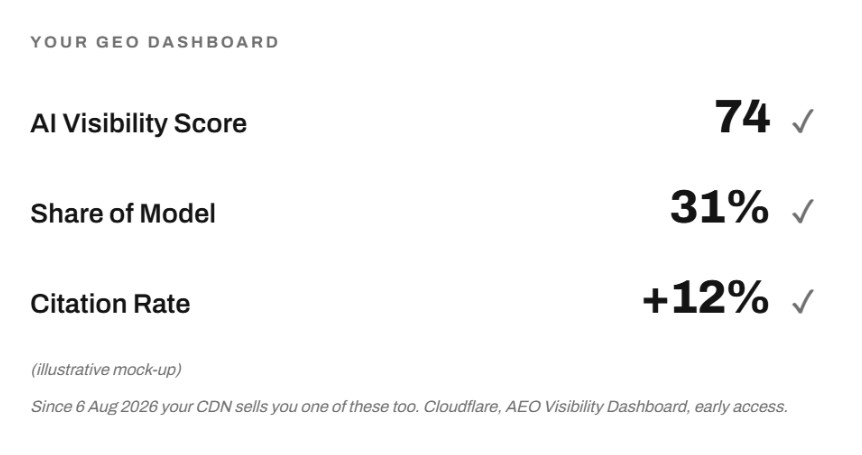
“As long as our KPI increases, I don’t care who did it.” – an enterprise client, 2026
The AI attribution crisis
70.6% of AI-driven visits land in “DIRECT” (no referrer) and only 29.4% are visible as AI referrals.
Three ways an AI visit goes dark
- Dark: Referrer stripped (apps, copy-paste, generated links) > filed under Direct.
- Masquerade: Gemini routes clicks via a Google results page > filed as Organic Search.
- Absorption: Click lands inside a live session > inherits that session’s channel. No AI trace.
Source: Loamly, 446,405 sessions. Live-tested on 4 assistants, twice, 12 hours apart. Behaviour changed between rounds. Verified Aug 2026.
The 7-layer AI signal stack
In Marketing We Trust’s answer to accurate AI attribution is a stack, not a metric.
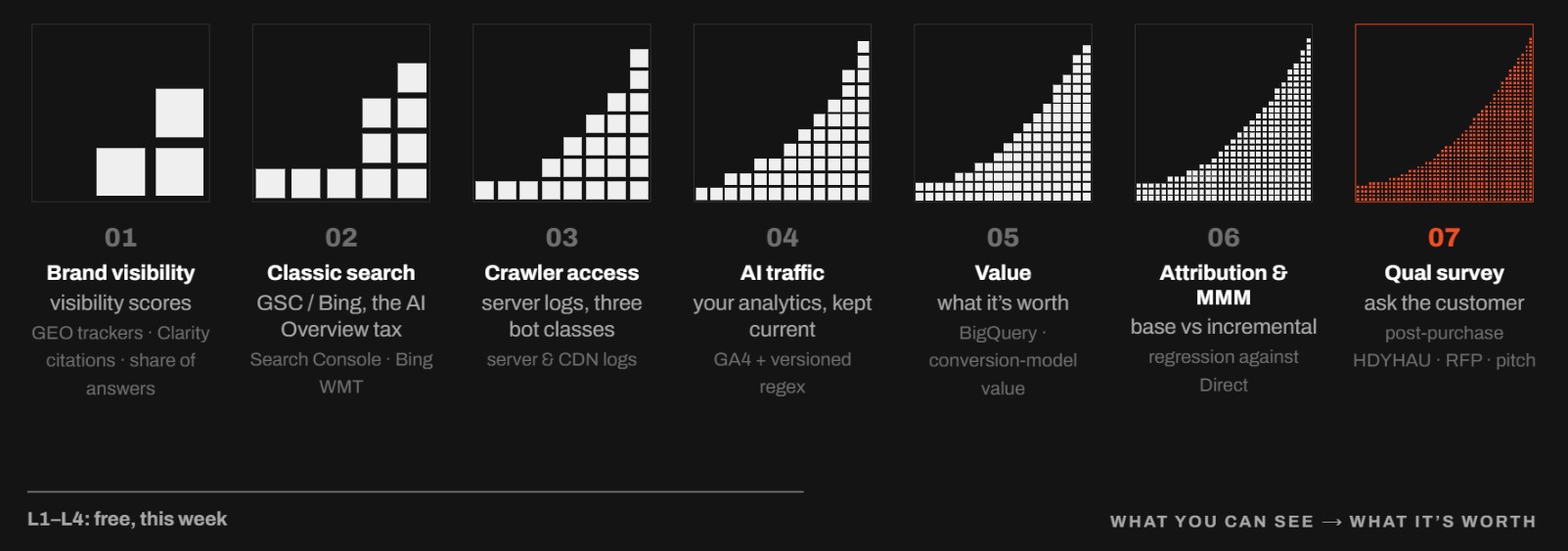
Every layer of the 7-layer AI signal stack measures the same reality. Only the resolution changes.
- Brand visibility: Visibility scores (GEO trackers, Clarity citations, share of answers)
- Classic search: GSC/Bing, the AI Overview tax (Search Console, Bing WMT)
- Crawler access: Server logs, three bot classes (server and CDN logs)
- AI traffic: Your analytics, kept current (GA4 + versioned regex)
- Value: What it’s worth (BigQuery conversion-model value)
- Attribution & MMM: Base vs incremental (regression against Direct)
- Qual survey: Ask the customer (post-purchase ‘how did you hear about us’, RFP, pitch)
Layer 1: Brand visibility
Layer 1: Brand visibility is where the industry stops and “Are we in the answers?” is the only question it addresses.
A few things before you dig into layer 1.
- PAR: Presence – Appearance – Relevance: This is the most rigorous visibility framing on the market. Still, it’s only layer one.
- Never measure from a logged-in assistant. It has memory. It flatters you. Clean sessions only.
- A page can be #1 on Google and invisible to GPTBot. Ranking ≠ retrievable ≠ cited.
Start free with Microsoft Clarity AI Visibility for layer 1 measurement. Keep in mind, it’s a useful reading, not yet a business case.
Layer 2: Classic search
Layer 2: Classic search and where our old friends grew new reports. The free tools already measure AI, and the trend only goes one way.
Google Search Console: Generative AI features – a hugely popular shopping site
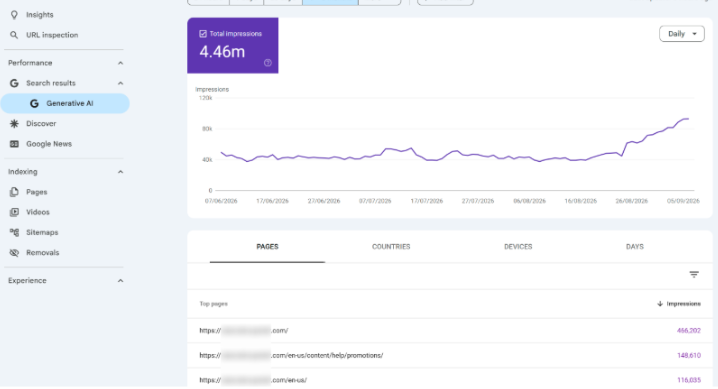
4.46m impressions from Google’s AI surfaces in 3 months, climbing since late Aug. Pulled Sep 2026.
Bing Webmaster Tools: AI performance – same site
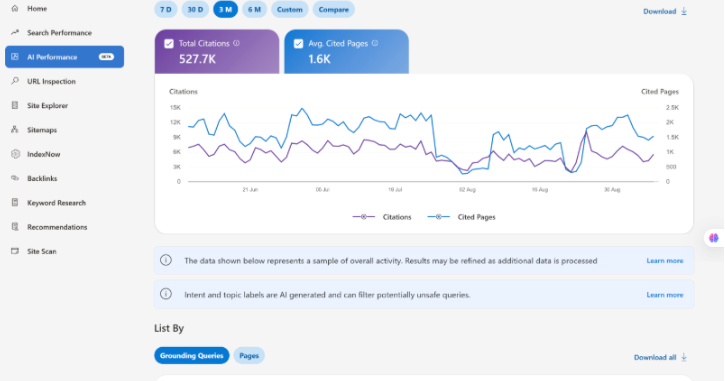
527.7K citations in 3 months, with the grounding queries behind each one. Copilot’s side of the story.
The odd one out. In the same report, “yes” appears on 10 of 10 client properties. Nobody typed it: AI Mode turns, unlabelled. Only 0.006% of impressions, but 99% land on the page for the specific thing the conversation was about. Not a metric. A tracer.
Source: One client property, GSC page report, 15 Aug 2025 to 14 Aug 2026. Portfolio denominators: ten properties, 8.25bn impressions, 81.4m clicks.
Layer 3: Crawler access
Now it’s time to read your logs.
Three AI relationships hit your site, wearing different user-agents:
- Training: Reads everything, sends no one (GPTBot, Claudebot)
- Indexing: Decides whether AI search can retrieve and cite you (OAI-SearchBot, PerplexityBot)
- Assistant: A live human, one second from being your visitor (ChatGPT-User, Claude-User)
The crawler you watch may not be the one doing the work. ChatGPT reads Bing, Claude reads Brave, Siri reads Gemini. A quiet log is not proof of absence.
Most analytics see none of this. Your server logs (and Cloudflare’s edge) see all of it.
Our confession
We measure this for a living and we still failed our own audit.
| Requests | Citations | Visits |
| 33,000 AI-crawler requests, 7 days (14.9% of all traffic) | 519 AI citations, 120 days (share of answers 20.3%) | ~2 visible AI referral visits (GA4, same week) |
Two instruments, two truths. Our log tool saw zero training bots. Cloudflare’s edge saw 33,000 a week. 43/100. No AI bot rules at all. A stray Crawl-delay: 10 throttling Bing, the index that feeds ChatGPT.
isitagentready.com. Free. Ten seconds. It caught us.
Source: inmarketingwetrust.com.au · Cloudflare edge via Microsoft Clarity AI Visibility · isitagentready.com, 17 Aug 2026
Layer 4: AI traffic
Time to capture your AI traffic. The list expanded, moving the leaks.
Example: A major theme park group in Analytics 360 over 28 days.
| Sessions | Revenue | Where |
| 806 AI sessions | $19,372 revenue | 99% filed under “Unassigned” |
Not mislabeled; uncategorised. The definitions predate AI. These visitors engaged +20% and stayed +50% vs site average.
The traffic is real. The value is real. The attribution isn’t.
- ChatGPT 46%
- Gemini 25%
- Claude 20%
- Perplexity 8%
- Copilot 3%
Google expanded the undisclosed list. Its docs still say “sources like ChatGPT, Gemini, Deepseek, Copilot, Grok”.
The leaks that remain:
- ~34% of Copilot and ~13% of Perplexity sessions still land in Unassigned or Referral: source variants and medium overrides.
- Kimi, Deepseek & the Asian assistants: zero rows: dark, or never firing the tag at all.
The AI traffic regex
Deploy this today. Twenty minutes only and it reads your history. A new custom channel group classifies your history the moment it exists. The fix costs twenty minutes and pays backwards in time.
The GA4 to BigQuery export is the opposite, forward only. Link it the same day.
The AI traffic regex: 28 referrer patterns, 19 platforms
chatgpt\.com|chat\.openai\.com|openai\.com|perplexity\.ai|claude\.ai|copilot\.microsoft\.com|edgeservices\.bing\.com|gemini\.google\.com|bard\.google\.com|meta\.ai|you\.com|poe\.com|chat\.deepseek\.com|deepseek\.com|chat\.mistral\.ai|mistral\.ai|grok\.com|phind\.com|kagi\.com|qwen\.ai|tongyi\.aliyun\.com|doubao\.com|kimi\.com|kimi\.moonshot\.cn|yiyan\.baidu\.com|ernie\.baidu\.com|chatglm\.cn|clova-x\.naver\.com
Note: x.ai is deliberately excluded, it overmatches (wix.ai). Add an OR condition: Session medium exactly matches ai-assistant.
Google’s native AI Assistants list is undisclosed and drifts. Read what it matches on your own property today rather than from the documentation, and re-check quarterly. Verified 13 Aug 2026.
Just four steps
- GA4 Admin, Data display, Channel groups, Create new channel group, starting from a copy of the Default group.
- Add a channel named AI Traffic. Condition: Session source matches regex, paste the regex.
- Drag that rule above Referral and above Organic Search. Rule order is the usual reason a new group looks broken, not the regex.
- Save, then add the group as a dimension alongside the default group.
Note: Create a new group. Never edit an existing one. Editing a live channel group rewrites the reporting history, and there is no undo.
The gap, computed
Example: A financial data company
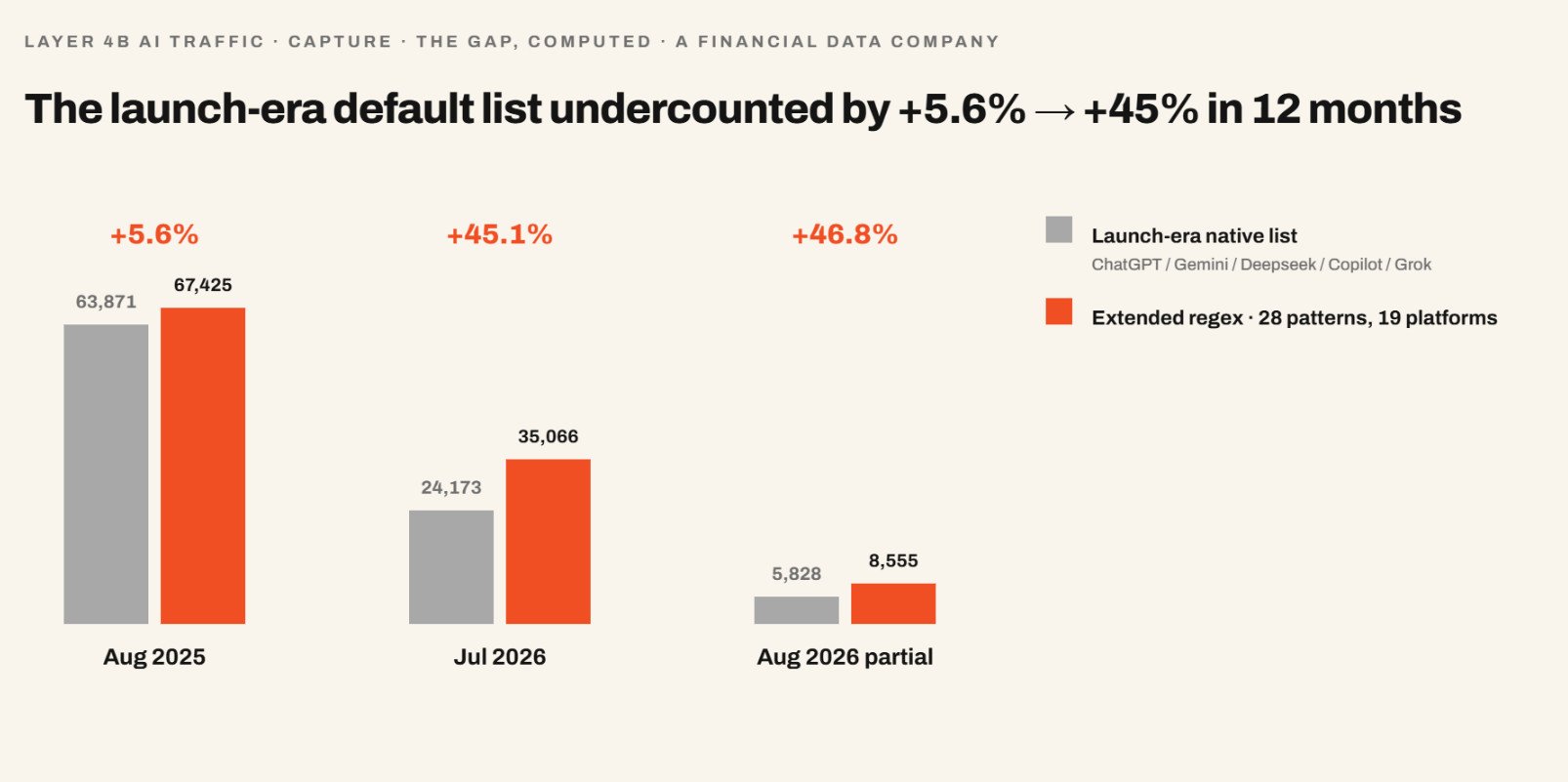
Google expanded the list later (quietly). The drift is real and the timing isn’t yours.
30M+ sessions, 2+ years. The miss compounded 8x exactly where growth was: Claude +253%, Perpexity +2,967%.
The bug: They matched “anthropic.com”. Claude sends “claude.ai”. Ten months invisible, one string.
A static definition goes stale without anyone noticing. Review Google’s and yours on a cadence.
Layer 5: Value
What’s an AI visit worth?
1 AI visit is worth 10 SEO visits or 22 Paid Search visits.
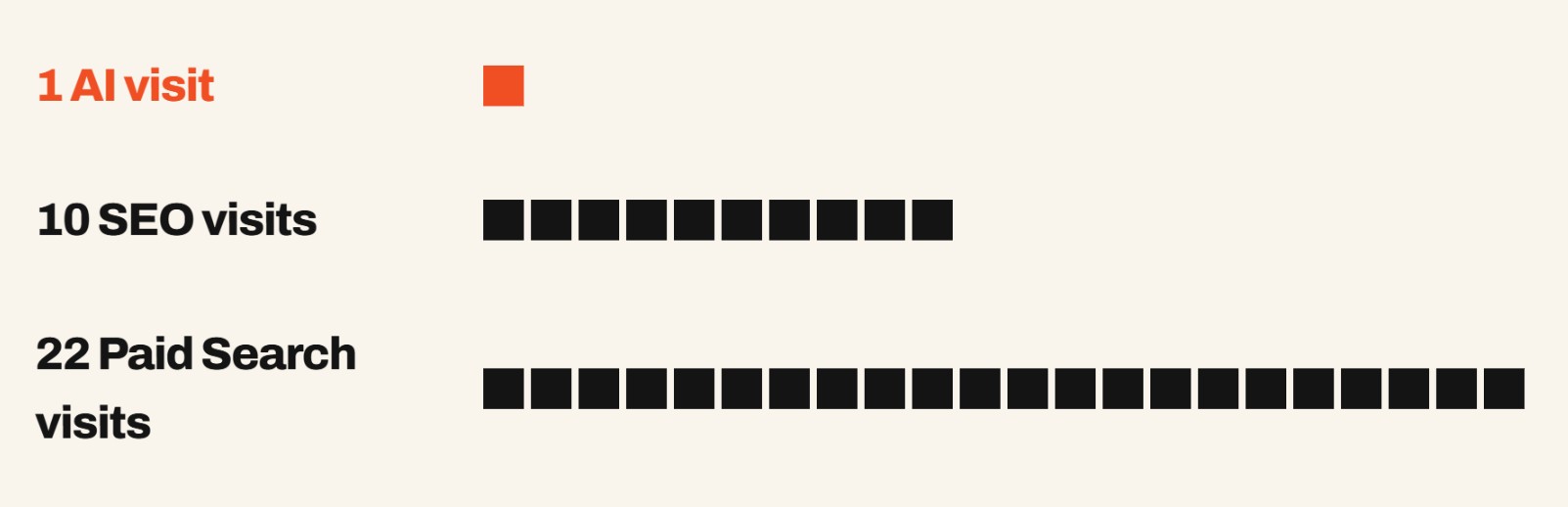
1 AI visit is worth 10 SEO visits or 22 Paid Search visits according to our own portfolio (CAC adjusted). These are our numbers, not universal constants. Treat this as a range.
Once layers 1 to 4 are live, this is the number to understand for your own business.
How to compute what an AI visit is worth to you
Two instruments agree. Then do it with your own data.

How to measure what an AI visit is worth to you
- Bucket sessions by referrer: AI platforms / organic search / paid
- Value per session per bucket: revenue per session (ecommerce), key events x your stated lead value (lead-gen), or ARPU (subscription)
- Divide by CAC per session: share of SEO + content cost for AI and SEO; ad spend for paid. The ratio falls out.
Layer 6: Attribution and MMM
Base versus incremental. How much was happening anyway?
The comparison that motivates the model:
10.21% dark-AI cohort conversion | 2.46% generic ‘Direct’
Honest limit: no clean geo holdout on organic AI visibility. So the grain is national time series and the methods are quasi-experimental, honestly labelled.
How it drops into a Meridian-style Bayesian MMM
- Variable · AI visibility as organic media: adstock + Hill saturation, no spend column. Series from your own stack: L1 share of answers, L3 citations, L4 AI sessions. Weekly.
- Carryover · Test longer adstock priors than paid search: answers keep recommending long after the crawl.
- Priors · Seed ROI priors from Layer 5 value per session. Set them wide: quasi-experimental, and the prior should admit it.
- Identification · The real enemy is collinearity. Control for organic impressions and seasonality, or the AI term steals SEO’s credit.
- Read-out · Posterior incremental contribution, credible intervals, never a point estimate. Calibrate on content canaries and time-based holdouts.
The methods are brand measurement, thirty years old. Only the input series is new.
Layer 7: Qual survey
Validate.
The ground truth? Just ask the customer.
“How did you hear about us?” Ask the same question in the same quarter. Real post-purchase surveys, new customers only.
Two examples:
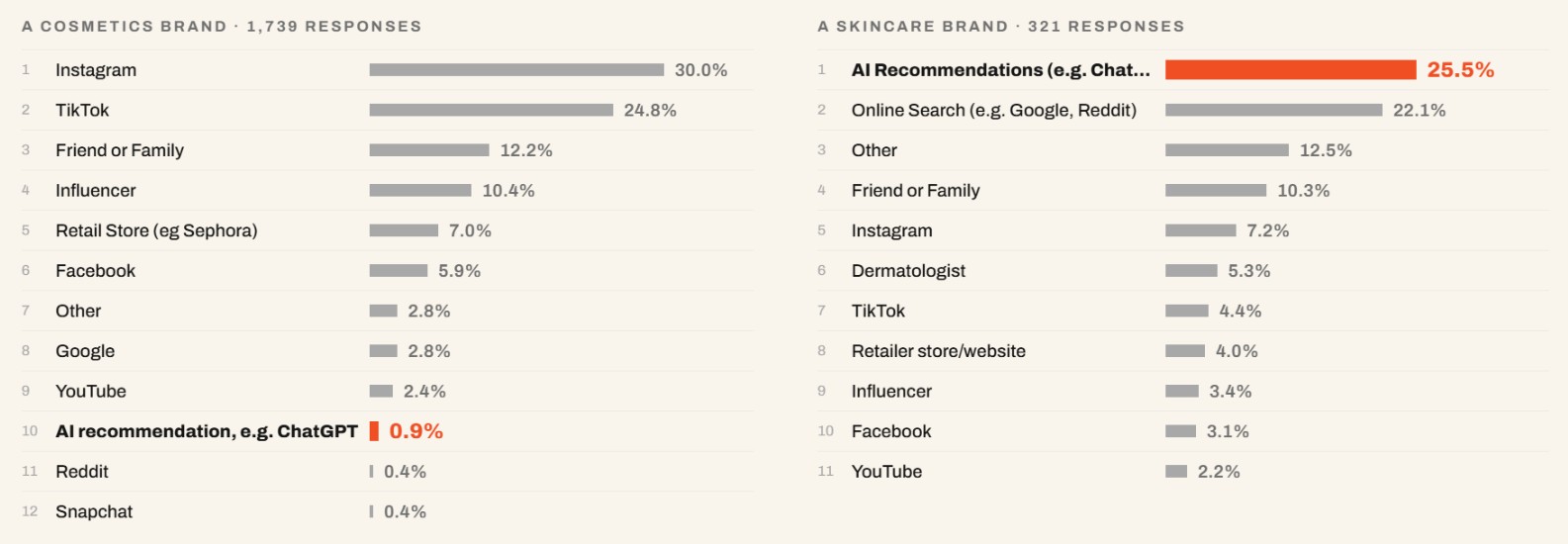
No tracking tool would have told you these two businesses live in different AI universes.
92% of B2B buyers say AI shaped their shortlist; 71% then visit the vendor site, mostly with no referrer. (Semrush, n=519, 2026).
Same question, same quarter, two brands: 25.5% and 0.9%. The spread is the finding. The question was identical, which is why the spread can be trusted.
Did AI make them choose us?
One question. Ask it in the right words for your business.
- Open text first, list second. A prompted list containing “ChatGPT” manufactures the answer you were hoping for. Ask open, code afterwards.
- Ask at commitment, not on the site. Order confirmation, booking confirmation, first invoice, won deal. Before that you are surveying browsers.
- One question. Every extra field halves the response rate, and the second question is always the one you drop later anyway.
| Single product purchase – eCommerce | Small business – local service | Large or repeat retailer | B2B – Considered purchase |
| “How did you first hear about this product?” | “How did you hear about us?” | “What made you choose us this time?” | “What did you use to research this, before you spoke to us?” |
| Not “about us”. The buyer remembers the product, not the brand, and asking about the brand returns “Google” from people an assistant sent. | The classic wording works here and nowhere else: the customer can usually name a single source. The one setting where a human asking beats a form. | Discovery happened years ago. The AI signal lives in the re-selection moment, not the discovery moment. “This time” is the whole trick. | At won-deal stage only, add: “did an AI assistant come up anywhere in your process?” Buyers under-report their own use and report the process accurately. |
CODE INTO: AI named (names a platform) · AI implied (“the chatbot”, “an AI thing”, “asked the AI”) · Search · Social · Word of mouth · Advertising · Cannot recall.
Code ‘AI named’ and ‘AI implied’ separately and report both. The implied bucket is usually the larger one, and it is the one that disappears if you only count platform names.
Where the stack lives
Was it your work, or the market? You can now price an AI visit, but can you tell whether this quarter moved because of what you shipped or because of what the economy did?
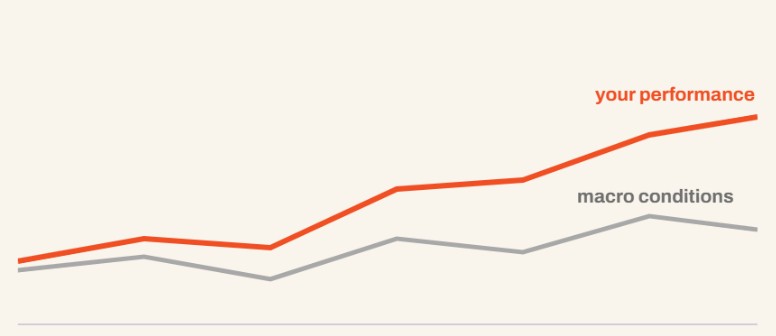
The gap between the two lines is the only number that proves your budget. Layer 6 gave you the language: base versus incremental.
The seven layers run inside our Strategic Framework. The Performance Optimisation Audit diagnoses how much of it was you, channel by channel. The overall Strategic Framework maps where customers actually choose and our measurement keeps the numbers trustworthy quarter after quarter.
Next Steps: Do this this week (all free)
- Deploy the AI Traffic channel group
Regex above to copy/paste (28 patterns, 19 platforms). It’s RETROACTIVE: you’ll see your history the moment it’s live. - Link GA4 → BigQuery TODAY
THAT is the stopwatch: it only collects forward. It’s the raw data behind every analysis in this post. - Check what you’re missing at the edge
Microsoft Clarity AI visibility (free) + 90 days of logs → your crawl-to-refer ratio. Then isitagentready.com: ten seconds. It caught us. - Add one post-purchase question
“How did you hear about us?”: 60% of your answer, one question. - Find the questions in Search Console
Filter queries to “yes”, then the Pages tab: a list of what your customers are asking assistants about. Five minutes.
Next time someone shows you an AI visibility score, ask the only question that matters: “What did it earn?”
Stuck on a layer?
Start this week: layers 1-4 are free and the above walks you through each. Make it easier for you and your team by downloading the deck for this talk/content here.
When you want a true read on your AI footprint, what it’s actually doing to performance, and a number that defends your budget, that’s what my team and I do. Contact us today for a free consultation.