How to Structure Your Team for Growth
How do you structure your team for growth in the age of AI? We’ll look at how CMOs can structure their teams for two shifts AI is driving: how customers discover and compare brands, and how marketing teams produce, review and deliver work. It covers who should own AI discovery, where technical specialists should sit, which decisions need to be shared across the business and how to tell whether the work is contributing to growth.
When a customer asks an AI assistant whether your product is right for them, the answer might draw on an old product page, a review and a customer forum. By the time that customer reaches your website, they may already have a shortlist. The CMO can see where the brand is losing ground, but the people who can update a product claim, fix an outdated help page or approve a correction may sit across different teams.
Mi3’s The Prompt Economy puts some numbers around that gap. Leopard analysed 31,200 AI responses about 27 brands across Australia and Britain. When a relevant question could be asked without naming the brand, the monitored brand was absent from 36 per cent of answers and mentioned but passed over in another 35 per cent. The implications vary by category but the findings do raise practical questions for CMOs. If AI is becoming a discipline in its own right, how do you give specialists clear ownership of discovery and workflows while making sure they can act on what they find across the business?
Why AI changes how marketing teams are structured
AI is changing two parts of the marketing team’s remit. The first is how customers discover and compare brands. The second is how the team gets work done. For CMOs, each raises a different question about ownership. Who can improve the information AI assistants use to recommend a brand? And who is accountable when AI takes on a step in a marketing workflow?
AI discovery needs an owner who can work across the business
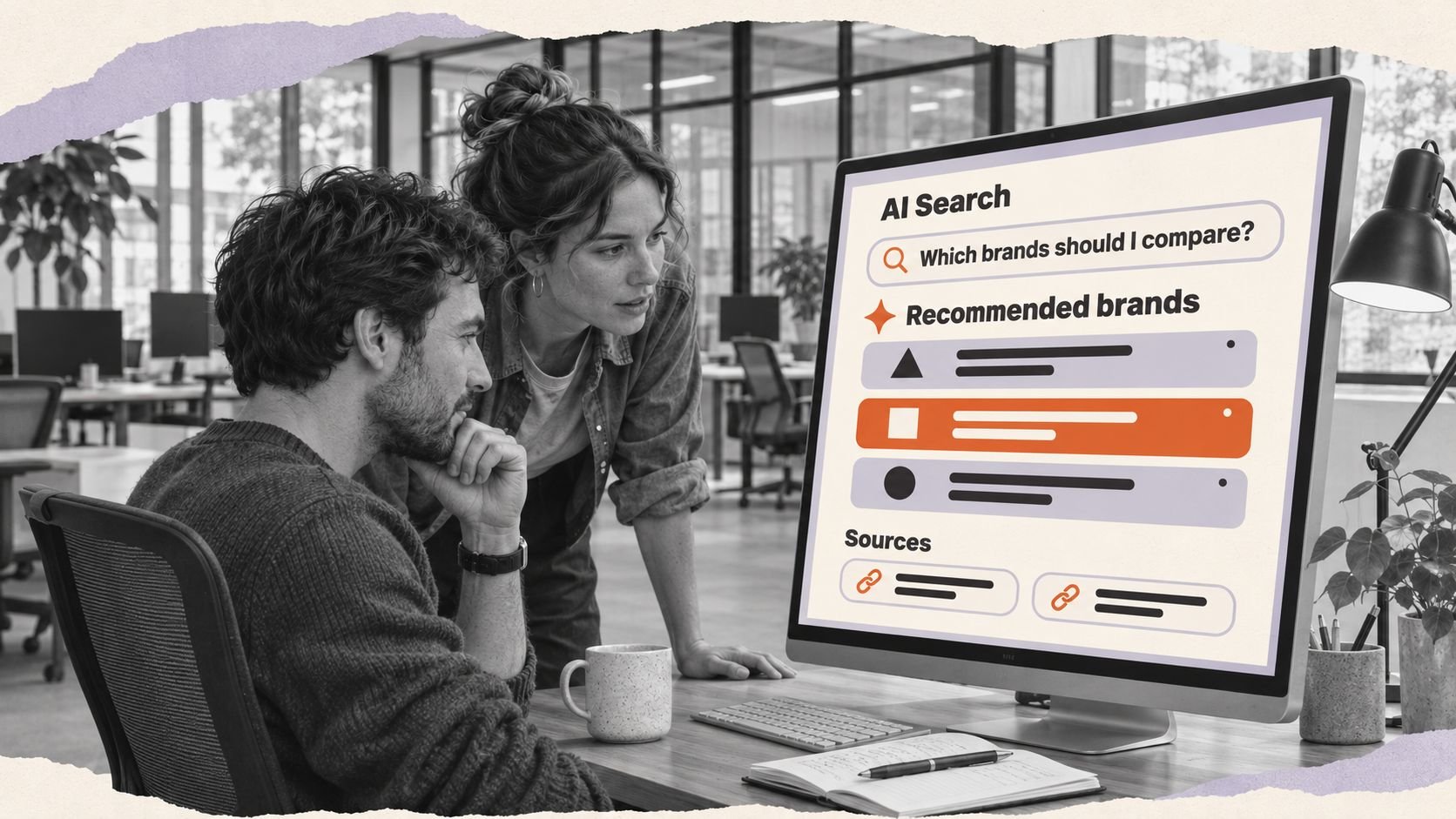
When a customer asks an AI assistant to compare providers, the answer may draw on product documentation, service policies, customer reviews and community discussions. Marketing can see where the brand is missing or poorly represented, but the fix may sit with the product team that owns an outdated help page, or the service team that can clarify a policy. The person responsible for AI discovery needs a way to get those changes made.
At BizCover, AI discovery helped shape the brief for a new head of marketing. CEO Michael Gottlieb told Mi3 the business needed someone focused on “new marketing angles, new initiatives, the new way of marketing”. Generative engine optimisation (GEO) is now a standing item in his monthly marketing report, and AI sources account for about 10 per cent of BizCover’s organic traffic, with ChatGPT contributing most of it.
AI inside the team changes where people spend their time
Inside marketing, AI can change when work gets reviewed and which decisions need a person’s attention. If a compliance check happens only after a draft is finished, even straightforward issues can send work back through the queue. Moving an initial check earlier gives marketers a chance to resolve those issues while they’re still developing the idea. That requires a workflow owner who can define what the agent checks, what goes to a human reviewer, and how the team measures the change.
BizCover publishes more than 500 ads, landing pages, blog posts and releases a month. Work was piling up at brand, risk and compliance checkpoints so the company introduced an AI agent with a human manager, KPIs and a development plan. Marketers now run rough ideas and drafts past the agent before they reach a human reviewer. Head of marketing Kristjan Smarason said that escalations to human review fell 60 per cent in the first year and 70 per cent in the year of reporting.
BizCover handled the two changes at different levels. It made discovery part of the marketing leadership brief and redesigned compliance review at the workflow level. The examples that follow draw on public accounts from around 15 brands over 18 months, primarily from Mi3’s The Prompt Economy (linked above) and Paul Hewett’s (CEO of In Marketing We Trust) Signals. They show where companies are putting these responsibilities, which decisions they share across teams and how they measure the work.
Give AI discovery a clear owner and share the work across teams
AI discovery needs a clear home in your team structure. Marketing should own how the brand shows up in AI answers and bring in specialists who can diagnose why it gets recommended or passed over. The teams responsible for the information behind those answers need to be able to act on what marketing finds. If an assistant cites outdated eligibility criteria, for example, marketing can spot the issue, but product and legal may need to agree on the correction.
That matters because customers are already using AI to make buying decisions. Research by The Navigators, cited by Mi3, found that 39 per cent of Australians had used generative AI to make a decision about a brand, product or service. Among under-35s, that rose to 54 per cent.
The evidence behind those recommendations explains why the work spans so many teams. Leoprd found that 86 per cent of citations came from outside the brands’ own channels, and more citations didn’t translate into stronger recommendations. An assistant might draw on product documentation, billing policies, customer reviews, press coverage and a years-old Reddit thread to answer a single question. Improving that answer can involve several teams, even when the issue first shows up in a marketing report.
Sitecore saw this when an audit revealed that AI systems were still citing old pages the company was preparing to delete. That finding changed the decision facing the business. Before retiring a page, the team had to consider what information the assistant was getting from it and where customers could find an accurate answer once it was gone. Sitecore CMO Michelle Boockoff-Bajdek described AI discovery as a company-wide discipline.
A practical starting point is to name an AI discovery lead in marketing, give them access to SEO and technical expertise, and agree who can prioritise changes in product, legal and customer service. Constellation Research’s Liz Miller rated CMO readiness at two out of ten, underscoring the need for dedicated expertise. Omnicom Oceania’s David Gatt warned that a standalone capability with its own technology, budget and reporting could leave the underlying fragmentation in place. The discovery lead needs a way to get issues onto other teams’ work plans and track whether the changes improve the answers customers see.
AI also changes how marketing teams produce, review and publish work. That calls for a different set of decisions about who designs the workflow, who checks the output and who signs it off. BizCover illustrates that side of the team design challenge. For CMOs tackling both, AI discovery has a customer-facing goal, while AI in production has an operational one. Each needs a clear owner and measures that reflect the work.
Give AI discovery a lead who can get work done
Appoint a senior marketer to own how the brand appears in AI answers. Search is a sensible home for the work. The team already knows how to identify the questions customers ask, trace the sources behind an answer and investigate why a competitor gets recommended. The lead’s job is to turn those findings into work the business can act on.
That requires a clear agreement about who fixes what. Search can flag an outdated product specification, but product needs to verify the correct details, and whoever owns the source needs to update it. If an answer reflects a recurring service complaint, customer service needs to be involved. Give the AI discovery lead a standing review with the relevant teams so each issue ends with a decision, an owner and a date to check what changed.
Sitecore found out why this matters when it was preparing to retire some old web pages. An audit showed AI assistants were still citing them in answers about the company. Sitecore updated the useful pages and brought together people from web, content, documentation, social, community, PR and customer advocacy. The group reviewed priority prompts weekly to see how assistants described Sitecore, which sources they relied on and where competitors were gaining ground. Sitecore reported that its share of voice in tracked AI answers rose from 6.7 to 12 per cent, while its mention rate across priority prompts rose from 23 per cent to nearly half. Both are company-reported visibility measures.
A regular review helps teams catch issues. A defined experiment gives them time to test a fix. HubSpot’s dedicated answer engine optimisation team works with colleagues in YouTube and runs six-week experiments with defined outcomes. For an enterprise marketing team, that could mean choosing a set of buying questions, agreeing which sources to improve and checking whether the answers become more accurate or recommend the brand more often.
Decide how far the CMO’s AI remit should extend
AI discovery needs a day-to-day owner. A broader executive remit makes sense when the mandate also covers decisions about customer-facing AI, shared data or technology investment. Before changing the org chart, spell out which decisions the executive will own, which teams or budgets they can direct and who will lead marketing day to day if the remit expands.
Several businesses have drawn those boundaries differently.
| Business | Executive structure | What it puts under common leadership |
| Veeam | Mika Yamamoto became Chief Marketing and Customer AI Officer | Global marketing and responsibility for a customer AI framework. Veeam |
| UKTV | Penny Brough became Chief Marketing & AI Officer, with Matt Berry as GM Marketing | Company-wide AI strategy sits with Brough, while Berry leads brand, channel and programme marketing. UKTV |
| Endeavour Group | Catriona Larritt became Chief Customer Officer | Marketing, insights, digital, ecommerce, data and AI, and loyalty. Endeavour Group |
| Woolworths | Interim CMO Michael Laxton moved into a dedicated Customer AI role | Customer AI has its own lead alongside a new CMO. Woolworths |
| Sainsbury’s | Mark Given became Chief Technology, Marketing and Data Officer | Technology, marketing, data and insights, and Nectar360, with the CTO reporting to Given. Sainsbury’s |
UKTV shows what an expanded remit can mean for the team underneath it. When Brough took on company-wide AI strategy, UKTV appointed a marketing deputy with explicit responsibility for the work that still needed to happen every day. The public announcements offer limited detail on budgets, team sizes and where AI engineers report. Before adopting a similar structure, specify who will make investment decisions, where technical capacity will come from and which marketing priorities the deputy will own.
Put technical expertise where the work happens
Start with a marketing workflow where delays or errors have a clear business cost. Campaign approvals are a good example. If compliance feedback comes in just before launch, a change to one claim can send copy, design and media teams back to work. Giving marketers access to that feedback when they’re still drafting can reduce rework and give reviewers more time for the decisions that need their judgement.
Give the workflow a marketing owner who understands how the work gets done and technical support from someone who can build, monitor and maintain it. Agree with the relevant review team on what AI can handle, when a person needs to step in and who can pause the workflow. Measure turnaround time alongside the quality of the published work. In campaign approvals, that means tracking what reaches publication as well as how much work goes to reviewers.
How much expertise to put inside marketing depends on the work. If several teams need ongoing engineering support, embedding engineers gives them the context to spot where workflows break and improve them as needs change. Thoughtworks moved its AI and Data team into the CMO’s office and put go-to-market engineers alongside marketers, with IT providing shared infrastructure and controls. Chime gives dedicated AI leads responsibility for priority initiatives and keeps creative judgement with its in-house creative team.
An existing role can also take on responsibility for a specific workflow. At Perk, a content operations role now manages AI processes, and the team has brought translation and localisation work in-house without changing its headcount. For CMOs, the practical question is who needs to be close enough to the work to improve it, spot problems and act when something goes wrong. The answer helps determine whether to expand an existing role, appoint a dedicated AI lead or embed engineering expertise in marketing.
Give AI an executive owner and make room for the work
When AI becomes part of the CMO’s remit, decide which decisions the CMO can make, who will lead delivery and which existing responsibilities can move. If the remit covers the whole business, agree with product, technology and other teams on who can commit resources and settle competing priorities.
That matters when an AI initiative needs the same engineering team as a product launch or the same marketing team as a major campaign. A named executive owner gives teams someone to turn to. Delegating day-to-day leadership gives that executive time to make the decisions only they can make.
UKTV created that capacity by appointing a deputy. Penny Brough took on company-wide AI strategy as Chief Marketing & AI Officer, and Matt Berry was appointed to lead brand, channel and programme marketing. Endeavour took a different approach, bringing marketing, digital, data, AI and loyalty under a Chief Customer Officer. UKTV’s structure shows how a business can make room for a wider remit through delegation. Endeavour’s shows how related customer functions can sit under one executive.
Share specialist expertise and keep customer priorities close to the business
Pool capabilities that several business units or markets need, such as engineering, production and measurement. Give each unit or market a say in which customer problems the shared team tackles first. Agree how to rank requests when demand exceeds capacity, using criteria such as customer impact, commercial value and urgency.
Sharing specialists gives teams access to expertise they may only need at certain points in a project. Local teams bring the context that determines where that expertise will have the most impact. A market might know why customers are abandoning an application, while a shared analytics team can test whether the same issue is costing sales elsewhere. When an agency provides part of the capability, name an internal owner who can connect it to the right teams and data, and assess the results against business objectives.
Commonwealth Bank’s announced model pairs three specialist CMO roles with an expanded internal agency covering creative, media, campaign delivery, content and social. Coca-Cola retains a global agency system and appoints different partners in some regions. Both illustrate how enterprises can share delivery capacity while giving business units or markets room to act on their own priorities.
Let search become the connector
For AI discovery specifically, the team most often given the job of joining things up is search. What changes is who the search team works with.
HubSpot has a dedicated answer engine optimisation (AEO) team that CMO Kipp Bodnar describes as increasingly integrated with the rest of marketing. It works with the YouTube team and on Reddit, in six-week experiments with defined outcomes.
At Webflow, Vivian Hoang joined to run SEO content. Within about 18 months her remit covered AI-search strategy, with brand, product marketing, community, content, affiliates and customer marketing all contributing.
Sitecore built a cross-functional discoverability squad spanning web, content, documentation, social, community, PR and customer advocacy. It meets weekly to review AI mentions, cited sources and competitor gains. Sitecore reports that its share of voice rose from 6.7 to 12 per cent.
Asana’s search team now works with PR, customer advocacy, community and video. CMO Prachi Gore explains why:
“In the past, with traditional search, you did chase third-party content, but it was very much from the intention of getting a backlink. In the new content world, third-party content is extremely critical, but written on their own domains. So we need to get more influencers, advocates and customers talking about Asana, because LLMs can read everything.”
At Twilio, the team in the loop includes engineering. It has optimised about 50,000 pages of technical documentation, which is built as code in GitHub.
Job ads show the same split. Databricks advertised a Principal Brand Content & AI Search Visibility role that joins brand storytelling with SEO and coordinates contributors, agencies and AI agents. Experian Health advertised an AEO & SEO Manager, an individual contributor reporting to the Digital Marketing Director. These are two different answers to where AI search capability belongs.
Not everyone agrees search should hold the pen. SEO being asked to coordinate more teams is only an advancement if the role carries enough influence to make that coordination stick.
Decide what’s shared and what sits with the business
Under all of this is an older question that AI has made urgent again: how much capability do you centralise, and how much do you push out to the business units?
CBA chose both. In October it announced three specialist CMOs: Di Everett for Brand & Olympics, Katreena Tyson for Business & Institutional Banking, and James Peereboom for Retail Banking. Alongside them sits an expanded in-house agency, CBAgency, led by Pat Crowley, which combines creative, media, campaign planning and delivery, content and social. All four report to Group Executive Marketing and Corporate Affairs Monique Macleod. CBA hasn’t linked the change to AI. Even so, a shared delivery engine sitting next to business-facing CMOs is an obvious place to house AI production tools and the people who run them.
Disney set up an enterprise marketing and brand organisation under Chief Marketing and Brand Officer Asad Ayaz in January. He reports to the CEO for the corporate role and to segment chairs for business-unit marketing. How those competing demands are resolved will matter more than the title itself.
Are Media went the other way, consulting on decentralising marketing roles across its four publishing verticals and moving decisions closer to each general manager. So the assumption that a more sophisticated marketing operation has to be more centralised doesn’t hold everywhere.
The agency side shows the same tension. Coca-Cola now uses different holding companies for different regions on one global system: WPP Open X globally, Omnicom in North America and Dentsu in Japan and South Korea. PepsiCo moved global media to Publicis under a “One PepsiCo” model that brings media together with identity, data and technology. Buying several capabilities can be easier than making them operate coherently.
What nobody has worked out yet
Almost everything above is an announcement, a job ad or an interview. Very little of it is a result. A few gaps keep coming up.
Measurement. Omnilux attributes 4 to 5 per cent of revenue to ChatGPT referrals on a last-click basis. Its VP of performance marketing, Caleb Orion, still says, “I don’t have a consistent measurement methodology for it.” Searchable followed shoppers after an AI shopping chat and found 47 in 100 went straight to Google within 30 minutes. The chat builds the shortlist, and Google gets the credit in your analytics. If you can’t see AI’s contribution, it’s hard to justify the team you built for it.
Authority. Most of these moves don’t disclose who controls the budget. HubSpot’s AEO team works across marketing, but nothing in Bodnar’s account shows it directing other teams’ spend. A title or a coordinating remit without budget can end up as a polite request.
Supervision. BizCover plans to grow from 31 digital employees to 250 within two years. Gottlieb admits the company hasn’t yet worked out how its management structure will handle that many. How many agents can one person manage? Nobody has published an answer.
Headcount. This is the question every CFO will ask. The best evidence so far points to changing jobs rather than removing them. Perk kept its numbers and changed the work. Gottlieb expects “less routine work, it’s more judgment, more customer care, more empathy,” and says he isn’t sure whether AI will reduce headcount at BizCover overall.
Our take on structuring your team for growth
AI is changing how customers find and engage with brands, how marketing teams create work and how they make decisions. As that happens, data, analytics, engineering and optimisation become more important to marketing strategy. We’re looking at whether the people doing that work get a bigger say in how marketing operates and how brands engage with customers, alongside their colleagues in brand and communications.
We use three pillars to describe where AI is changing marketing.
- Engagement: how people use platforms and technology to discover, evaluate and engage with brands.
- Production: how marketing teams create, adapt and evaluate assets using AI.
- Operations: how teams activate, measure, coordinate and make decisions with AI, improving quality and speed.
Three pillars of AI in marketing
Engagement, production and operations: three areas where AI reshapes future-ready marketing. Data, engineering and optimisation support all three.
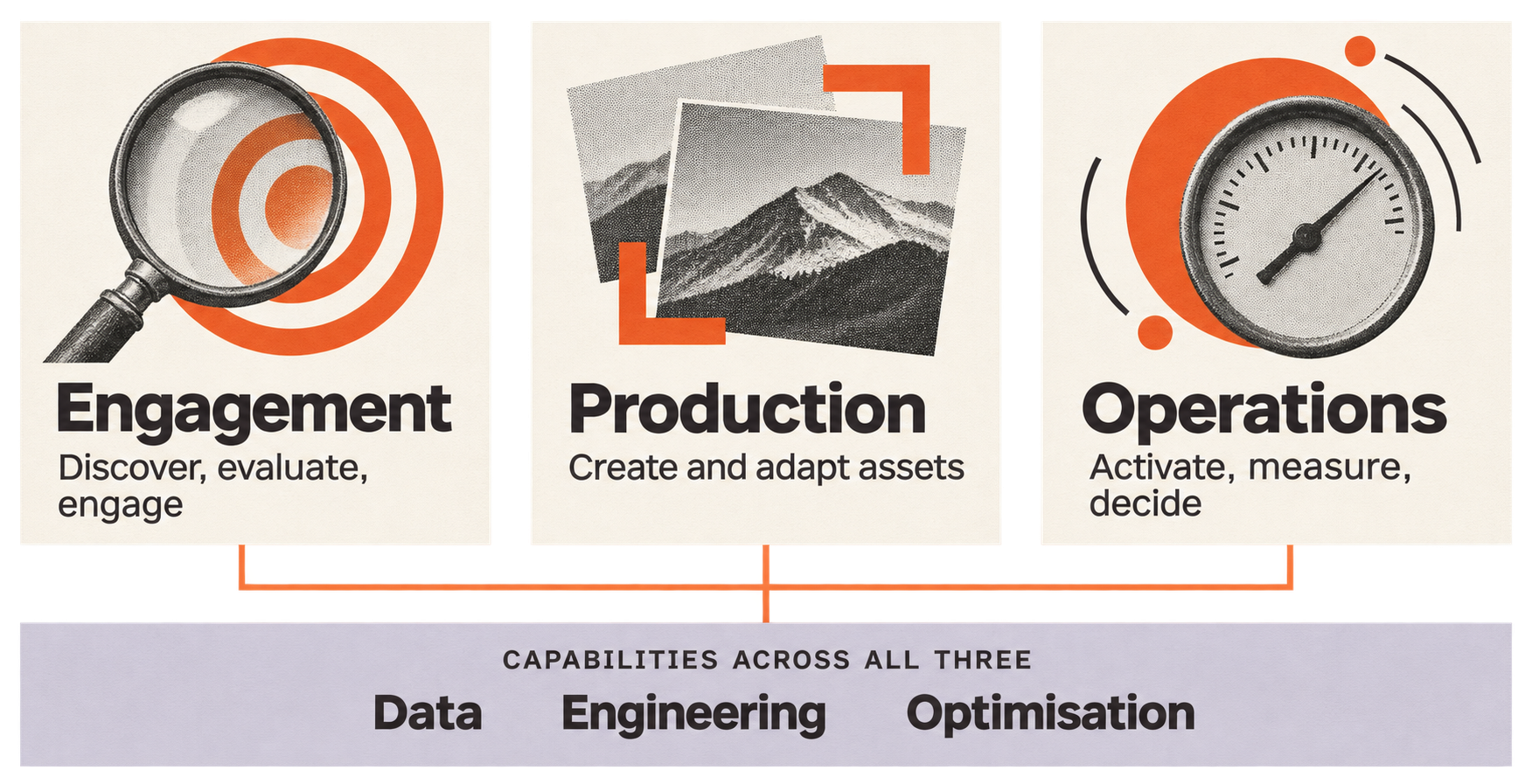
Data, analytics, engineering and optimisation run through all three. The question we’re testing is whether growing demand for these skills gives the people using them more influence over marketing priorities and decisions.
If the work becomes more technical and the same people still make the decisions, that weakens the hypothesis. So would a pattern of these capabilities moving into other parts of the business while the role of marketing specialists stays the same. Job ads and appointment announcements show what companies intend people to take on. Accounts of how teams operate show what companies say they’ve put into practice.
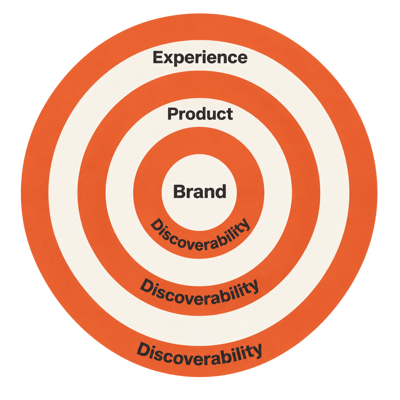
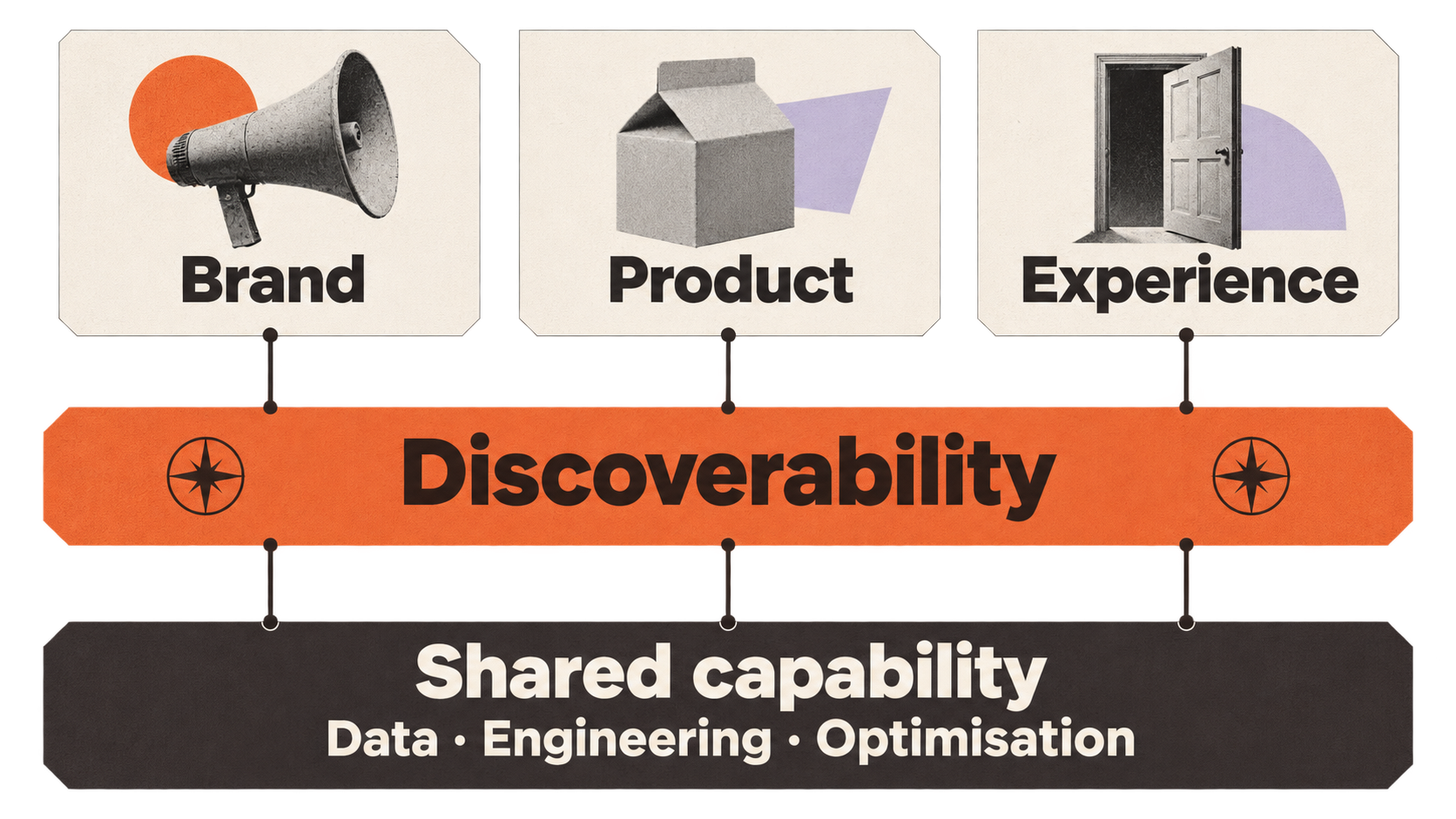
Discoverability is something marketing teams need to build into brand, product and customer experience. The circles show how those areas connect, and the shared layer shows where data, engineering and optimisation can support them. Both diagrams are working models being updated as our research progresses.
Discoverability at every layer
Brand, product and experience each need to be discoverable. Discovery can begin at any layer.
Shared capability for future-ready marketing
Data, engineering and optimisation support brand, product and experience. This describes capability, not reporting lines.
How to Structure Your Team for AI Discovery
Redesign your roles before you cut headcount, however, a broader title is not a measure of success. This is why we built our strategy framework, so AI search, paid media and analytics are planned together rather than channel by channel.
What to do now
- Give one senior marketer responsibility for coordinating AI discovery with authority to involve product, customer, communications, data, technology, and legal teams.
- Begin with two or three customer questions that matter commercially. Map the answers, sources, and gaps, plus the owner of each corrective action.
- Review your findings regularly and escalate stalled work. Coordination without time, authority or accountability becomes another bottleneck.
- Keep ownership where the truth lives. Marketing can organise the response but it shouldn’t rewrite product facts, service failures or legal decisions.
- Report recommendations and business impact separately from raw visibility.
AI search is making the seams and silos in marketing visibile. There are many ways enterprise brands are currently going about structuring their team for growth. At the very least, the above will help you to produce, maintain, and prove what your brand wants to be known for.
What to do next
What to watch and ask next:
- Which capabilities grow, combine or move as marketing is restructured?
- How do internal teams, embedded partners and specialist agencies work together? (coming soon)
- What can international teams share, and where does local expertise remain essential?
- How do privacy, data and AI responsibilities change the marketing operation?
- Which structures improve marketing effectiveness as well as production efficiency?
Stay up to date with our research over at paulthinks.com with regular updates and signals across changing marketing operations and how to structure your team for growth.