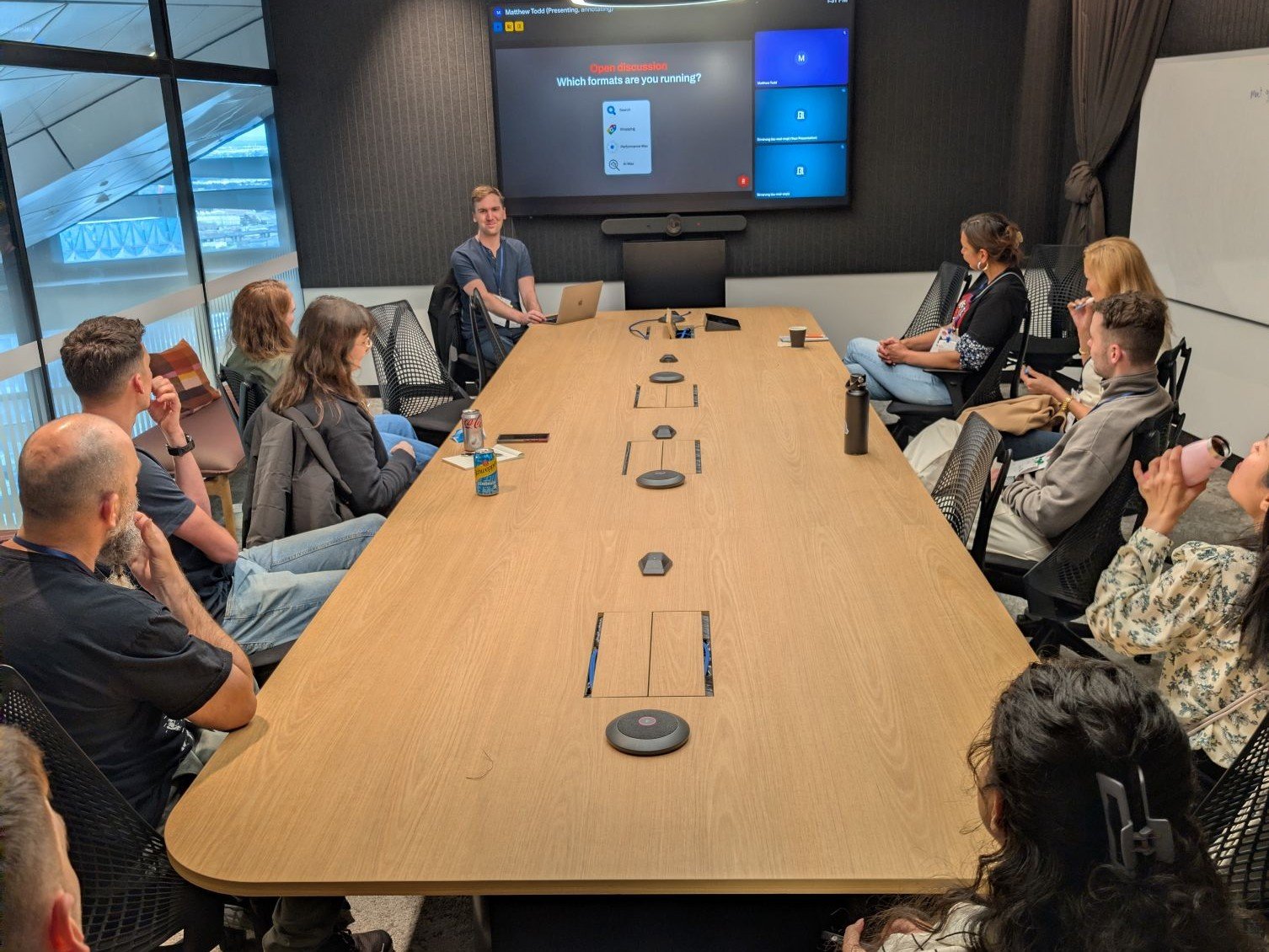
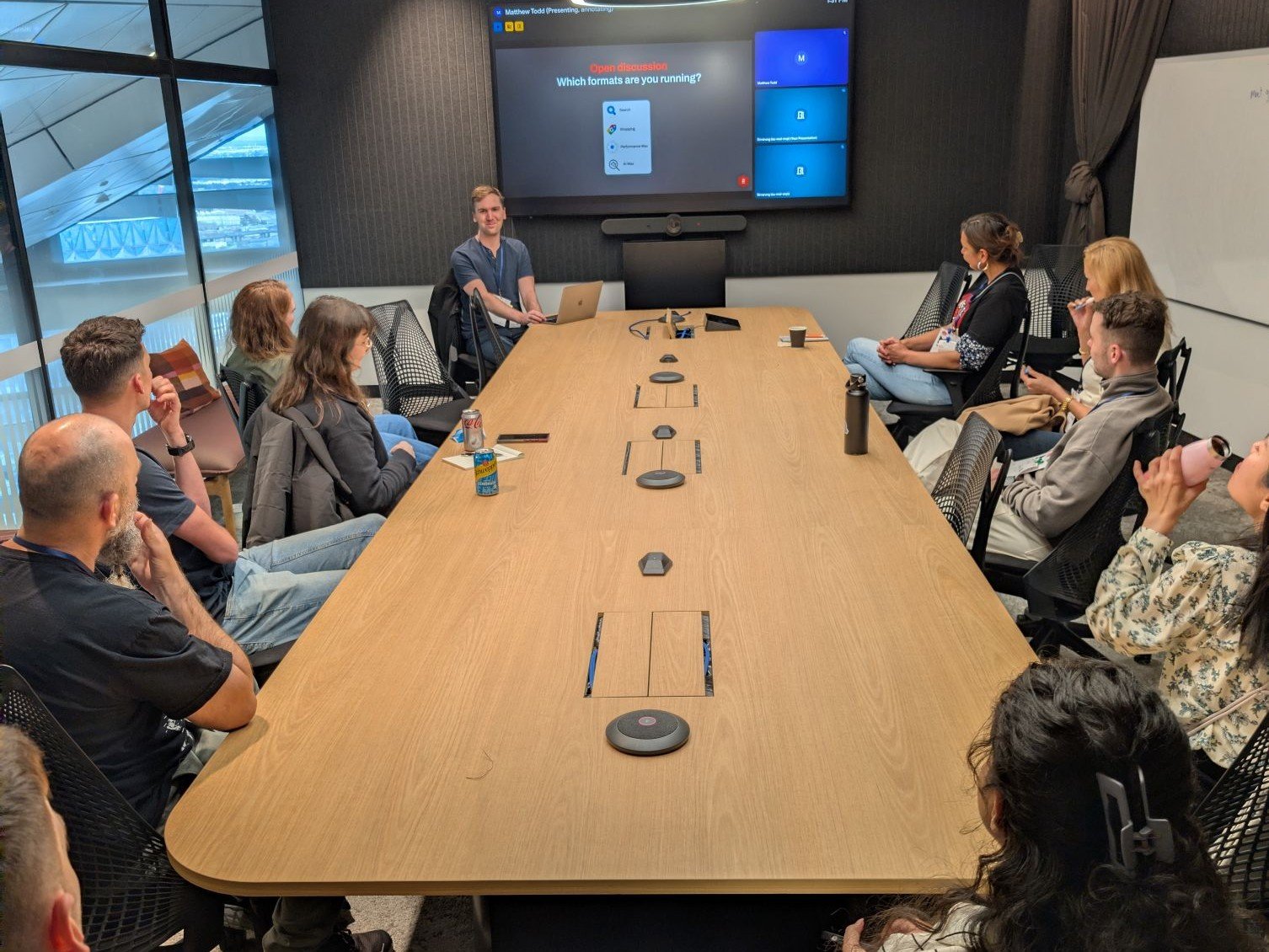
It was great to take the stage (or table, rather) at MeasureCamp Melbourne and talk through something that’s been front-of-mind for everyone in paid search right now: how Google’s AI Mode ads and AI Overviews ads are reshaping the advertising landscape – and, critically, what we as marketers actually need to do about it.
What Are AI Mode & AI Overviews, Exactly?
For anyone who needs a quick refresher: both products were released in Q4 2025 in Australia. They are powered by Google Gemini and represent Google’s direct response to the rise of AI-powered search tools like ChatGPT and Perplexity, which have already become global staples.
The two formats behave differently on the search results page. AI Mode sits as a separate tab on the search listing page, while AI Overviews surface inline on select query result pages. AI Overviews tend to trigger for three types of searches:
AI Overviews Trigger For
- →
Complex queries – things like “how to fix” searches where a synthesised answer adds clear value - →
High-intent research – comparison queries such as “iPhone vs Samsung for battery life” - →
Open-ended questions – broad queries that require pulling from multiple sources to build an answer
Google’s stated goal is to enrich the user experience – and that philosophy extends to the ads people see within these responses. Rather than interrupting the flow of an AI-generated answer, the intention is for ads to feel like helpful, context-driven suggestions that are relevant to what the user is actively researching.
“Because of this, only select ad types can serve in AI Mode and AI Overviews – they provide the flexibility needed to match ads to the nuanced meaning of a query, rather than relying on rigid keywords.”
That last point is the big one. We are entering the keywordless targeting age. The question is how prepared your campaigns are for it.
Which Campaign Types Are Eligible?
Not every campaign format can serve in these placements. The eligible types are:
Performance Max
AI Max
All of these formats share one thing in common: they give Google’s machine learning the creative and contextual flexibility it needs to match ads to intent signals beyond a simple keyword match. If you’re running standard keyword-heavy Search campaigns without any of the newer AI-driven formats, you may find your eligibility – and reach – is becoming increasingly constrained over time.
AI Is Only as Good as the Signals You Feed It
This was a theme I kept coming back to throughout the session. The machine learning underpinning these formats is genuinely powerful, but it is not magic. The outputs are only as strong as the inputs you provide. Those inputs fall into two buckets:
Data Inputs
Creative · 1st Party Data · Historical Data · Audience Signals
Human Inputs
Targeting Strategy · Test Framework · Creative Strategy · Monitoring & Optimisation
The AI handles the optimisation mechanics. Our job, and this is where human expertise remains absolutely essential, is to define the paid media strategy, build the testing framework, feed in quality signals, and monitor performance with a critical eye. The two work together; neither replaces the other.
Businesses seeing the strongest results are combining AI-driven automation with experienced paid media specialists, robust data analytics capabilities, and a clear roadmap for adopting AI and agentic solutions across marketing operations.
AI Max – Best Practice Guide
AI Max is Google’s newest Search campaign feature and the most direct way to access the expanded reach of AI Mode and AI Overview placements. Here is what I recommended for teams testing it:
01
Integrate your 1st party data
Use exclusion audiences and, where possible, set up automatic integrations with your CRM or customer data platform (CDP) so that suppression lists stay current and accurate.
02
Build negative keyword lists before launch
Put these in place prior to enabling AI Max so you are guiding the algorithm from day one – not cleaning up irrelevant traffic after the fact. Ongoing reviews are essential; this is not a set-and-forget task.
03
Max out your creative assets
Use every available headline, description, and ad extension slot. The more creative variation you provide, the more the algorithm has to work with when matching your ad to a contextual query.
04
Test on campaigns with conversion history first
Launching AI Max on a campaign that already has meaningful conversion data gives the algorithm a head start on learning what “good” looks like for your account.
05
Smart bidding is a requirement – start there
If you haven’t already adopted smart bidding on your Search campaigns, do that first. Max Conversions is a solid starting point before moving to AI Max.
06
Test on one campaign, not your whole account
Don’t roll AI Max out across everything at once. Pick one campaign, test thoroughly for sale or lead volume, cost, and lead quality before scaling further.
07
Opt out of ad copy and URL optimisation settings
This gives you more control over the creative being served and makes it easier to draw a direct performance comparison between your campaigns before and after AI Max was enabled.
08
Allow at least 14 days before making major changes
Give the algorithm adequate time to learn and stabilise. Making significant changes in the first two weeks will interrupt the learning phase and make it harder to read the results clearly.
Shopping & Performance Max – What to Prioritise
For those running Shopping and PMAX campaigns – particularly in e-commerce – the core principles are consistent with AI Max, with a few format-specific nuances worth calling out.
Applies to Both Shopping & PMAX
Shared Best Practices
- →
Use exclusion audiences from your 1st party data to suppress existing customers or unqualified segments - →
Maintain negative keyword lists and review them regularly - →
Optimise towards maximum conversion value or ROAS – this ensures profitability is baked into the machine learning objective, which is especially important for e-commerce where order value varies - →
Use a variety of high-resolution images – creative is a first-class input in these formats, not an afterthought - →
Monitor performance from October 2025 onwards, tracking transaction volume and cost per sale – all campaigns are eligible for AI Mode and AI Overview placement by default, so historical baselines matter
Performance Max Specific
PMAX Additional Actions
- →
Feed audience signals into your PMAX campaigns to help the algorithm build efficiencies faster – don’t leave it to figure out your audience entirely on its own - →
Use all available ad extensions, descriptions, and headlines to maximise the creative pool available to the algorithm - →
If running a PMAX Shopping setup, use an automated product feed where possible to keep attributes current in real time – including product titles, descriptions, discounts, and offers – so the AI has the richest, most accurate data to work from
One important note for everyone: because all campaigns are eligible for these placements by default, your existing campaigns have already been exposed to this inventory since it launched in Australia. If you haven’t already looked back at your performance data from Q4 2025 onwards, now is the time. If you’re seeing performance shifts, work closely with your Google Ads reps to discuss optimisation options specific to your industry vertical.
Reporting – Stay Ahead of Public Releases
One final point I wanted to leave the room with: the reporting available for these formats is evolving quickly, and there are real advantages to staying close to Google’s beta programme. As a concrete example, Reporting became available via beta in May 2025, well ahead of its planned public release in November 2025. That is a 6-month information advantage for teams who engage with beta releases.
Staying informed about what is available – and actively requesting access to relevant betas through your Google Ads rep – is a meaningful competitive edge right now. The teams that have the most granular performance data earliest will be best positioned to optimise their accounts as this landscape continues to evolve.
“The keywordless targeting age is not something to resist – it’s something to equip yourself for. The fundamentals of good paid media strategy haven’t changed; the tools have.”
Thanks to everyone who came along to the session at MeasureCamp Melbourne – the open discussions around AI Mode Ads, AI Overview Ads, and the formats you’re actively running were genuinely valuable, and exactly the kind of peer exchange that makes MeasureCamp worthwhile. Looking forward to continuing the conversation.