Australia’s privacy regulator is becoming more proactive. That matters for marketing leaders, even if this initially appears operational or sector-specific.
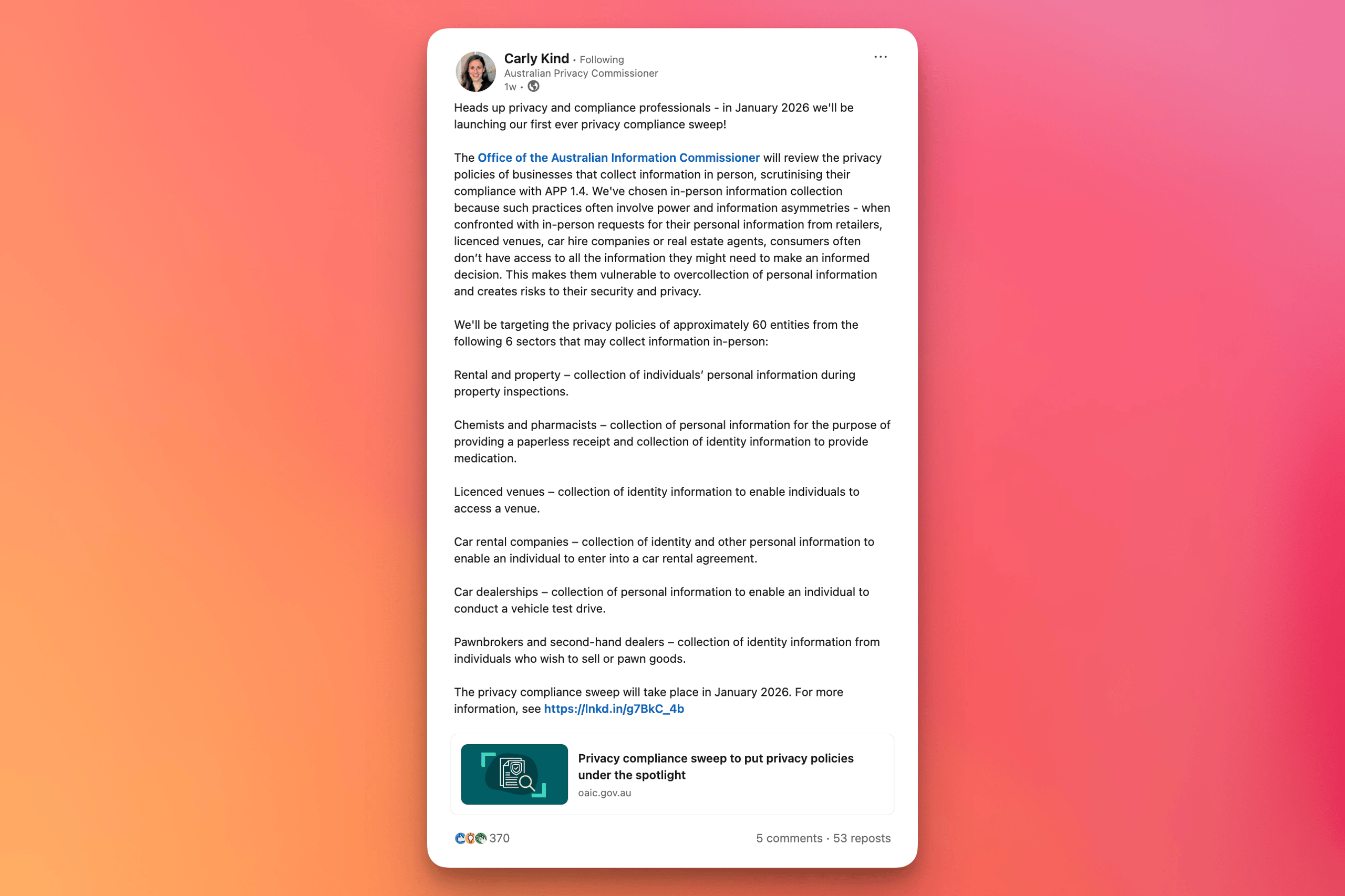
Earlier this month, the Australian Privacy Commissioner, Carly Kind, announced that the Office of the Australian Information Commissioner will run its first privacy compliance sweep in January 2026.
The sweep will review the privacy policies of approximately 60 organisations across six sectors: rental and property, pharmacies, licensed venues, car rental companies, car dealerships, and pawnbrokers. The focus is on how personal information is collected in person, with enforcement action available where entities are found non-compliant with Australian Privacy Principle 1.4.
For many marketing leaders, this announcement will appear confined to specific industries and collection contexts. It will be easy to assume it has limited relevance outside those environments.
That assumption would be a mistake.
The Signal Beneath the Sweep
The Commissioner has been clear about why in-person collection was chosen. These environments often involve power and information asymmetry. Consumers are asked for personal information in situations where refusal is difficult and where they lack clear visibility into what is being collected, why, and how it will be used.
This is not a narrow operational concern. It is a regulatory signal.
The OAIC is signalling concern about situations where people cannot meaningfully understand or control the collection of their personal information.
Now consider the modern marketing stack.
Most customers have no visibility into what flows through a tag management system. They cannot see what a CDP aggregates, which platforms receive audience data, or which third-party pixels fire during a checkout or form submission. The information asymmetry in digital environments is often greater than it is in face-to-face interactions.
This sweep is not about nightclubs or pharmacies. It is about the regulator moving from reactive complaint handling to proactive enforcement, starting where the risk is easy to explain and expanding from there.
What APP 1.4 Actually Requires
The compliance sweep will assess adherence to Australian Privacy Principle 1.4, which sits within APP 1 on open and transparent management of personal information.
APP 1.4 requires privacy policies to clearly set out:
- The kinds of personal information collected and held
- How that information is collected and held
- The purposes for collection, use, and disclosure
- How individuals can access and correct their information
- How complaints are handled
- Whether personal information is disclosed overseas and, if so, where
This is not a box-ticking exercise. The principle requires policies to be accurate, current, and accessible.
For marketing teams, the overseas disclosure requirement is particularly relevant. Most analytics platforms, CDPs, ad platforms, and experimentation tools involve offshore processing. If your martech stack has changed and your privacy policy has not, there is likely a gap between policy and reality.
Where Marketing Teams Are Exposed
Marketing functions typically control or influence a significant share of personal information collection.
That includes direct collection through forms, events, loyalty programs, and lead capture. It includes indirect collection via analytics, behavioural tracking, and audience segmentation. It also includes downstream data entering CRM systems from sales, retail, or partners.
The risk is not malicious intent. The risk is incomplete visibility.
Many marketing leaders cannot confidently describe what data is actually being collected across their digital properties, particularly within analytics and tag management environments.
The Accidental PII Problem
Personal information regularly enters analytics platforms unintentionally.
Email addresses appear in URLs via password resets or campaign parameters. Form values are captured in query strings. Site search logs contain names, phone numbers, or addresses. User ID fields are populated with email addresses rather than pseudonymous identifiers. Custom dimensions quietly store identifiable data.
This typically breaches both platform terms of service and Australian Privacy Principles. Personal information is being collected without clear notice, often beyond what the privacy policy describes.
These issues are common. They are rarely discovered without deliberate review.
The Tag Management Blind Spot
Tag management systems make deployment easy and oversight difficult.
It is not unusual to see dozens of third-party scripts firing across key pages, each with its own data access and sharing behaviour. Over time, this creates a collection surface area that few organisations can clearly articulate.
Simple questions often expose the gap:
- Do you know every script running on your site?
- Do you know what data each one accesses and where it is sent?
- Is each collection point reflected in your privacy policy?
- Could a customer reasonably understand what is happening?
If the answer is unclear, governance is likely insufficient.
What Marketing Leaders Should Do Now
Waiting for the regulatory lens to widen is a poor strategy. The better approach is to treat this announcement as a prompt to audit reality.
Start by mapping actual data flows. Document what is collected at each touchpoint and where it goes. Include analytics, tag management, CDPs, CRMs, and advertising platforms. This is about accuracy, not aspiration.
Audit analytics implementations for personal information. Review URLs, parameters, custom fields, and user identifiers. Where personal information appears, stop collection at the source and address historical data appropriately.
Review your tag inventory. Identify every third-party script, what it collects, and where data is sent. Remove anything that cannot be justified, documented, and governed.
Reconcile policy with practice. Compare your data map to your privacy policy. Identify gaps in collection types, third-party disclosures, and overseas processing. Update the policy to reflect reality, not the other way around.
Establish ongoing governance. Privacy reviews should be triggered by any new tool, pixel, or data collection change. Without this discipline, policies drift out of sync quickly.
Document your compliance posture. If challenged by a regulator or customer, evidence matters. Keep records of audits, remediation, and governance processes.
The Broader Context
The January 2026 sweep is unlikely to be the last. The OAIC has expanded enforcement powers, including infringement notices, and recent amendments to the Privacy Act reinforce a more assertive regulatory stance.
At the same time, community expectations are shifting. Opaque data practices are increasingly questioned, and trust is becoming a competitive differentiator.
For marketing leaders, this is no longer theoretical. If you own the martech stack, you own a material part of the organisation’s privacy risk.
The real question is whether that risk is being governed deliberately or discovered reactively.
How We Work With Teams
At In Marketing We Trust, we help marketing teams understand what is actually happening inside their analytics and martech ecosystems.
Our work focuses on visibility first. We identify where personal information is being collected intentionally and accidentally, map real data flows, and assess alignment with privacy obligations. From there, we help teams establish governance that keeps pace with how marketing actually operates.
Get in touch to discuss how we can help you improve the effectiveness of your marketing data while ensuring it is governed and compliant.