
Travel Digital Digest
Marketing Intelligence Weekly

Weekly updates on the digital marketing news you need to know for the travel industry, including the latest news in travel, ai in the travel industry, data privacy, platform updates, travel marketing trends and more.

AI in travel
Booking.com: Don’t Chase Every AI Shiny Object
- Booking.com’s Chief Business Officer James Waters says travel brands should stay focused on traveller and partner needs rather than getting distracted by the latest technology trends.
- While AI is generating excitement, Waters believes there’s still a major gap between consumers finding AI interesting and trusting it to make travel decisions on their behalf.
- He argues that travel’s emotional and financial stakes make AI adoption more complex than in many other industries.
- Read more
Travel by numbers
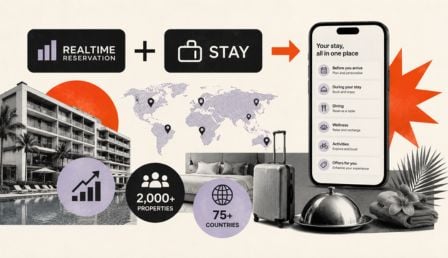
Hotel Tech Merger Targets Guest Spending Growth
- Hotel commerce platform RealTime Reservation has acquired guest experience app STAY, creating a combined platform serving more than 2,000 properties across 75+ countries.
- The deal brings together pre-arrival planning, upselling and in-stay services such as dining, wellness and activity bookings into a single guest journey.
- The acquisition reflects the growing importance of ancillary revenue, as hotels look beyond room bookings to drive growth and loyalty.
- Read more

Travel by numbers
Chinese Travellers Put Flexibility First
- New research shows 67% of Chinese travellers prioritise flexible or refundable bookings, as geopolitical tensions and travel disruptions increase uncertainty.
- Awareness of refund protection products is high in China (73%), with purchase intent reaching 88%, highlighting growing demand for risk-reduction tools.
- Nearly 30% of travellers are delaying bookings, with almost half of Chinese travellers waiting until closer to departure before committing.
- For travel marketers, flexibility is becoming a key conversion driver, with reassurance and booking protection playing a bigger role in purchase decisions.
- Read more

Platforms in travel
Expedia Automates More Travel Agent Workflows
- Expedia TAAP has launched a new back-office API that automatically syncs booking and commission data with agency systems, reducing manual admin work.
- Travel advisors can now add their own reference codes to bookings, making it easier to track trips, manage clients and reconcile commissions.
- Real-time booking and earnings notifications give agencies better visibility and allow Expedia TAAP data to flow directly into operational and financial systems.
- Read more

AI in travel
Lastminute.com Cuts Jobs to Fund AI Push
- Lastminute.com plans to cut 25% of its workforce as part of a major restructuring designed to accelerate AI adoption across the business.
- The company expects the changes to deliver €16 million in annual savings from 2027, with funds redirected into AI, data infrastructure and specialised tech talent.
- Management says AI is reshaping how travellers discover and book trips, making early adoption critical to staying competitive.
- Read more
AI in travel
Platforms in travel
Virgin Takes Flight Search Into ChatGPT
- Virgin Australia has become the first Australian airline to launch flight search functionality directly inside ChatGPT, allowing travellers to search fares, destinations and Velocity Reward Seats using natural language prompts.
- The new experience lets users describe their travel needs conversationally and compare cash fares, Points + Pay options and Reward Seat availability in one place, removing the need to jump between multiple web pages.
- For marketers, it's another sign that AI is rapidly becoming a discovery and commerce channel. Virgin is effectively bringing its booking experience into a platform millions of Australians already use for research and decision-making.
- Virgin Australia CEO Dave Emerson called the launch "a significant milestone for Virgin Australia and Velocity Frequent Flyer and for the future of travel", adding: "We're giving our customers a faster, more intuitive way to plan and book their trips, all within a platform many are already using every day."
- OpenAI ANZ Head of GTM Satya Tammareddy said: "Australians are already turning to ChatGPT to plan, compare and make everyday decisions, and travel is a natural extension of that shift." Virgin has also flagged future ChatGPT features including international flight search, partner airline rewards, seat map insights and day-of-travel flight information.
- Read more

AI in travel
Platforms in travel
Travel by numbers
Why Most Hotels Are Invisible to ChatGPT
- Lighthouse analysed more than 4,500 ChatGPT prompts and found that AI recommendations are heavily concentrated among a small group of hotels. In some markets, up to 90% of hotels never appeared in recommendations, creating a significant visibility challenge.
- Large hotel chains have a major advantage. Marriott alone captured more than a quarter of all branded hotel mentions in the US, while independent hotels were significantly underrepresented compared to their share of available inventory.
- AI strongly favours four and five-star hotels, even when users provide little detail in their search. The language used across hotel websites, OTA listings and editorial coverage plays a key role in determining which traveller segments AI recommends properties to.
- Around 82% of the information AI uses for hotel recommendations comes from OTAs, metasearch platforms and editorial sources. However, when travellers click through from AI recommendations, they are most often directed straight to hotel websites, making AI visibility a growing direct-booking opportunity.
- Read more

Travel by numbers
Hotels Struggle to Keep Pace with Video-First Travel Discovery
- YouTube has now overtaken Netflix in average daily viewing time, highlighting a major shift in consumer behaviour that is reshaping how travellers discover and book trips. Hotels are finding it difficult to keep up with the speed of these changes.
- Radisson Hotel Group says hotels have a "speed problem", with legacy technology and operating models struggling to adapt to increasingly fragmented customer journeys across search, social, video and AI-powered platforms.
- Video is becoming a critical part of the booking funnel. Google reported strong growth in travel-related YouTube searches and views, while TikTok says 80% of travellers have had purchase decisions influenced by user-generated content on the platform.
- Video platforms are rapidly moving from inspiration to transaction. Google is integrating shopping features into YouTube, while Booking.com and Expedia have joined TikTok's new in-app booking programme, increasing pressure on hotel brands to be present where travellers are consuming content.
- Hotels need to rethink their commercial strategy by bringing marketing, distribution and revenue management closer together, investing in real-time data feeds, and partnering with technology providers that can help them adapt faster to emerging channels and AI-driven discovery.
- Read more
AI in travel
Platforms in travel
Expedia’s AI Lesson: Trust Before Speed
- Expedia Group says its early chatbot experiments revealed a key issue: travellers quickly lose trust when AI responses are not grounded in real booking, inventory and reservation data. The company found that generic AI answers led users to abandon the experience.
- “And so when we shipped this chatbot, we tried to see what kind of questions people were asking, and slowly we realized that if we weren't grounding our generic responses in our data, in our inventory, in our rates of reservations, customers were just like, ‘this is not working for me, I'm going to leave.’” Shilpa Ranganathan, chief product officer at Expedia Group.
- After pulling back from some early AI initiatives, including its Romie assistant, Expedia spent the past year investing in AI foundations, evaluation frameworks and scalable architecture rather than rushing new features to market.
- Chief Product Officer Shilpa Ranganathan stressed that AI experimentation is easy to start, but success should be measured by customer adoption and whether the technology solves a real user problem, not by the novelty of the AI itself.
- Expedia is encouraging employees across the business to test AI use cases, while balancing experimentation with accountability for delivering tangible customer value.
- One of the biggest challenges isn't the technology, but organisational change. Expedia sees AI adoption as a culture and change-management challenge, requiring employee buy-in, access to tools and clear links between AI projects and business outcomes.
- Read more

Travel by numbers
Hostels Face Growing OTA and Pricing Challenges
- Cloudbeds’ 2026 State of Hostels Report, based on 32 million bookings across 180 countries, found the hostel sector is becoming increasingly fragmented, with performance varying significantly by region, accommodation type and operating model.
- OTAs continue to strengthen their grip on hostel bookings, accounting for 73.7% of bookings globally. Some markets now exceed 80% OTA reliance, creating greater dependency on intermediary platforms.
- OTA bookings also drove significantly higher cancellation rates, with 20.7% of OTA reservations cancelled compared to just 9.2% for direct bookings, highlighting the value of direct booking strategies.
- Looking ahead to 2026, key growth opportunities include experience-led travel, longer stays from digital nomads, sustainability initiatives and AI-powered operations, while operators increasingly seek unified technology platforms to simplify management and improve performance.
- Read more

Travel by numbers
New Data Shows Travellers Prioritising Local Escapes
- Domestic travel is accelerating across G20 markets, with the share of hotel searches made within travellers' own countries rising from 54.1% to 57.5% year-on-year in Q1 2026. By April, 60% of hotel searches were domestic, signalling a clear shift towards staycations and closer-to-home travel.
- North America is leading the trend, with domestic hotel search share increasing 7% in the US, 10% in Canada and 13% in Mexico. Rising travel costs, geopolitical uncertainty and visa restrictions are encouraging travellers to swap long-haul trips for domestic alternatives.
- The move away from long-haul travel is widespread. European Travel Commission data shows a year-on-year increase in travellers saying they have no intention of taking a long-haul trip, while more Europeans are planning to stay within the continent for their next holiday.
- Travellers are also becoming more budget conscious. The proportion of European travellers expecting to spend more than €1,500 on a trip has dropped significantly, while shorter stays and shorter booking windows continue to gain momentum.
- For marketers and hotel operators, the takeaway is clear: demand is shifting towards domestic and regional audiences. Success will depend on targeting nearby travellers, adapting offers for shorter and lower-spend trips, and using forward-looking search data rather than relying on last year's booking patterns.
- Read more

AI in digital
AI in travel
Platforms
Platforms in travel
Google Finally Reveals AI Search Visibility Data
- Google Search Console now includes dedicated reporting for AI search experiences.
- Marketers can track AI-driven impressions across AI Overviews, AI Mode and Discover.
- Data can be segmented by page, country, device and date.
- Click data isn’t included, so traffic impact remains unclear.
- The rollout is limited for now, with wider access expected later.
- Read more

Platforms
Platforms in travel
Google Maps Becomes the New Discovery Engine
- Google is increasingly surfacing curated lists in Maps, effectively telling users where to go instead of just showing nearby businesses.
- Early observations suggest these recommendations are being generated from trusted user-generated content, including detailed reviews, photos, videos and list-style content.
- This could create a new local SEO opportunity, with businesses needing to optimise for inclusion in Google's AI-curated lists, not just rankings.
- The shift reflects Google's broader move from search results to recommendations, helping users make decisions faster.
- For marketers, visibility in Google Maps may increasingly depend on generating authentic customer content and reviews that Google can use as recommendation signals.
- Read more

AI in travel
Hospitality Giants Unite Around AI Standards
- The newly formed AI Hospitality Alliance Advisory Board brings together leaders from OpenAI, AWS, Microsoft, Wyndham, Choice Hotels, Oracle and other major players to guide AI adoption across the hospitality industry.
- The group aims to develop industry standards, governance frameworks and education programs as AI reshapes how travellers discover, book and experience travel.
- Members argue the industry risks falling behind without a coordinated approach to AI, citing fragmented tools, unclear standards and a lack of shared governance.
- For marketers, the move signals that AI is becoming a strategic priority across the travel sector, with brands increasingly focused on AI-driven discovery, distribution and guest engagement.
- Read more

AI in digital
AI in travel
Platforms
Reddit Doubles Down on Its AI Value
- Reddit CEO Steve Huffman says modern LLMs “would not exist as we know them” without Reddit’s vast archive of user-generated conversations.
- Huffman described Reddit’s content as “modern oil” for AI, reinforcing why the platform is licensing data to companies like Google and OpenAI while pursuing legal action against unauthorised scraping.
- For marketers, the comments highlight Reddit’s growing influence in both AI training and AI search, making authentic community discussions increasingly valuable for brand visibility.
- Reddit is also positioning itself as a key AI player, using AI to improve search, moderation and discovery across the platform.
- Read more
AI in travel
Travel by numbers
OTAs Keep Spending Despite AI Efficiency Hype
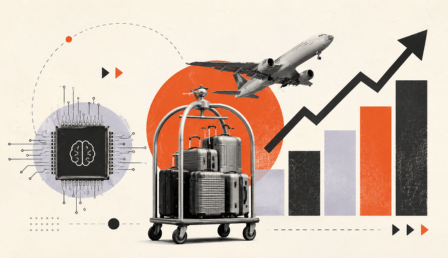
- Major travel platforms are still increasing marketing spend, despite expectations that AI would improve efficiency and reduce acquisition costs.
- Booking Holdings spent US$2.1 billion on marketing in Q1 2026 (+16% YoY), while Expedia and Airbnb also lifted investment.
- Travel brands are using AI to improve conversion rates and marketing performance, but the savings are being reinvested into growth rather than reducing budgets.
- For marketers, the takeaway is clear: AI may improve efficiency, but competition is ensuring those gains are quickly reinvested into customer acquisition
- Read more

Travel by numbers
Global Tourism Grows, But Headwinds Mount
- International tourism grew 2% in Q1 2026, reaching 307 million travellers, but growth slowed sharply in March as conflict in the Middle East disrupted travel patterns.
- Rising airfares, flight disruptions and higher fuel costs are weighing on demand, with travellers increasingly choosing destinations closer to home.
- Europe and Africa led growth, while the Middle East saw arrivals fall 14%; Asia-Pacific remained below pre-pandemic levels despite continued recovery.
- For travel marketers, geopolitical uncertainty is reshaping destination demand, making agility and regional market diversification more important than ever.
- Read more
AI in travel
Platforms in travel
Travel by numbers
AI Travel Discovery Is Splitting In Two
- AI traffic remains tiny compared to traditional search for travel brands. Aleyda Solis’ study found organic search drives 21.43% of visits across Travel & Tourism sites, while AI traffic accounts for just 0.12%, reinforcing that SEO is still the dominant acquisition channel.
- Travel marketers should stop treating AI citations and AI clicks as the same thing. The research shows AI citations often surface discovery and evaluation content, while actual AI-driven clicks are concentrated on brand, booking and transactional pages.
- Google AI Mode is already having a larger impact in travel than several other industries. Travel recorded the highest share of AI traffic coming from Google AI Mode at 10.1%, making it a space worth monitoring as Google's AI experiences expand.
- Visibility in AI search is becoming broader than traffic alone. Many travel pages may influence travellers through AI-generated answers without receiving a click, meaning destination guides, support content and informational resources can still create value even when referral traffic is low.
- AI search performance needs a new measurement framework. For travel brands, success is no longer just about sessions and rankings. Marketers should separately track AI visibility, citations and referral traffic to understand where they are influencing traveller decision-making.
- Read more

AI in travel
Platforms in travel
Travel by numbers
AI Travel Discovery Is Concentrated Among a Few Key Players
- More than a third of US travellers now start their research with AI tools instead of traditional search, making AI-generated recommendations a critical new battleground for airlines and hotels.
- The top 15 brands account for roughly 72% of all AI travel citations, leaving the remaining 28% split across dozens of competitors. In some travel categories, the top three brands capture more than 70% of total visibility.
- Booking platforms are losing ground in AI-generated travel discovery. Airbnb ranks 8th at 3.8%, Booking.com sits at 3.3%, and Expedia trails at 2.1%, suggesting AI is increasingly answering travel queries before users reach OTAs.
- The study analysed 60+ traveller prompts, 25 travel brands and responses across five AI engines: ChatGPT, Claude, Perplexity, Gemini and Google AI Overviews. More than one-third of US travellers now begin travel research with AI rather than traditional search.
- For marketers, the key takeaway is that Generative Engine Optimisation (GEO) is becoming just as important as SEO. Brands that build authority across the sources AI platforms trust are likely to gain a compounding advantage in future travel discovery.
- Read more
AI in travel
Platforms in travel
Travelport, Cognizant and Anthropic Team Up for AI-Powered Travel
- Travelport has partnered with Cognizant and Anthropic to embed Claude AI across its travel retailing and distribution platforms, aiming to modernise how travel technology is built, tested and maintained. The goal is to bring AI deeper into booking, servicing and travel operations.
- The collaboration is tackling a growing gap between how travellers now search for trips using AI and how existing booking systems process and fulfil those requests. Travelport’s new architecture is designed to translate conversational AI requests into real-time, bookable travel options.
- For travel management companies and agencies, the platform will automate manual tasks such as exchanges, rebookings and disruption management. Travelport says even saving one hour per agent per day could translate into millions of dollars in productivity gains for large travel businesses.
- The first rollout will focus on Travelport Trip Services, which handles bookings, refunds, exchanges and customer servicing. Initial customer-facing AI features are expected to launch later this year.
- “What Travelport aims to do with Cognizant reflects what modernization can look like in a complex industry. Reasoning across large, complex codebases is where Claude is at its best — and that’s exactly what travel infrastructure demands,” said Rich O’Connell, Head of Alliances, Anthropic.
- “AI is not a future consideration, it is happening now, and the companies that move fastest and most intelligently will define the next era of travel technology,” said John Mangelaars, CEO, Travelport. “Collaborating with Cognizant and Anthropic gives us a genuine AI superpower. Anthropic brings the most capable AI models and tools; Cognizant adds engineering talent and development capability to deploy them at scale; and Travelport brings the travel infrastructure and the partner network that connects it all to the real world of distribution and bookings.”
- Read more

AI in travel
Platforms in travel
Expedia Opens Inventory to AI Agents via MCP
- Expedia is opening its inventory to agentic AI partners via an MCP server, letting third-party AI agents connect directly to its travel supply. The goal is to stay central as travellers shift from branded platforms to tools like ChatGPT, Claude and Perplexity.
- The strategy includes three building blocks: an AI Toolkit, the Intelligent Experience Platform and the MCP server. Together, they help Expedia’s 75,000 B2B partners build AI-powered travel experiences faster.
- Expedia is also expanding its B2B travel chain through acquisitions, including CarTrawler for ground mobility and Tiqets for activities. Its ambition is to become a “one-stop shop for B2B travel”.
- The risk is that Expedia becomes an invisible inventory provider behind other AI interfaces, rather than the booking engine customers recognise. Its bet is that scale, service quality, proprietary data and 24/7 support will keep it valuable.
- Read more
AI in travel
Travel by numbers
AI Investment Surges for Travel Operators
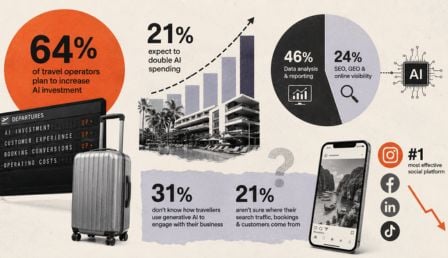
- Nearly two-thirds (64%) of travel operators plan to increase AI investment over the next 12 months, with 21% expecting to double spending as they chase better customer experiences, stronger booking conversions and lower operating costs.
- Beyond customer service, the biggest expected impact of AI is in data analysis and reporting (46%), followed by SEO, generative engine optimisation (GEO) and online visibility (24%). Travel brands are increasingly focused on how they appear across AI-powered discovery platforms.
- Many operators are still flying blind when it comes to AI-driven customer behaviour. Around 31% don't know how travellers are using generative AI to engage with their business, while 21% aren't sure where their search traffic, bookings and customers are coming from online.
- Instagram is now viewed as the most effective social platform for marketing and business generation, outperforming Facebook and LinkedIn. Meanwhile, confidence in TikTok's marketing impact has dropped compared to last year.
- The broader trend is clear: travellers are increasingly blending AI tools, social media and traditional search when researching and booking trips. Brands are responding by investing across AI, content and social channels simultaneously rather than treating them as separate ecosystems.
- “Search behaviors are changing and becoming more nuanced across the market,” said Thauan “Ty” Albuquerque, sales manager for TravelTech Show. “This is the generation which is increasingly combining AI with social media to research, book and pay for trips.”
- Read more

AI in digital
AI in travel
Platforms
Platforms in travel
Google Search Enters Its AI Agent Era
- Google has unveiled a major AI overhaul of Search powered by Gemini 3.5 Flash, shifting the experience from traditional keyword queries to more conversational, context-aware interactions. Users can now upload PDFs and images, ask longer questions and continue conversations directly within search results.
- Paul Hewett, CEO of In Marketing We Trust, called it “the biggest search box redesign in 25 years, plus a significant shift with information agents.” He added: “AI overviews and AI mode now chain together with context preserved. The unit of brand visibility isn’t being cited once, it’s being cited and surfaced in the follow-ups.”
- Google’s new “intelligent search box” behaves more like a chatbot, automatically generating nuanced prompts and independently monitoring research topics. The company is positioning Search as a full AI-powered journey rather than a static results page.
- Search will also begin creating lightweight apps and visual tools on the fly. Examples include personalised travel planners that combine calendar events, location data and real-time conditions to generate tailored recommendations.
- Google is also leaning into “agentic” AI capabilities, where assistants can complete tasks like booking services, monitoring live events and sending alerts. These features are expected to roll out later this year.
- Read more

AI in travel
Data privacy in travel
Platforms in travel
OpenAI Privacy Shift Could Reshape Travel Marketing
- OpenAI’s April privacy update is raising concerns across the travel industry because user interactions with AI tools may become less visible to brands, advertisers and intermediaries. That could reduce the amount of customer intent data travel marketers have historically relied on.
- There’s growing concern that AI platforms like ChatGPT could strengthen the position of major intermediaries such as Booking.com, Priceline and Tripadvisor if their inventory becomes the preferred source for AI-powered recommendations and bookings.
- The shift could also accelerate the need for structured, machine-readable content. Travel brands need to optimise websites and product feeds for AI agents rather than just human users and search engines.
- The new privacy policy raises red flags for potential exposure under emerging AI regulations, including the EU AI Act, as travel companies increasingly rely on third-party AI platforms to influence recommendations, pricing visibility and customer interactions. Brands may face growing legal and compliance risks if they cannot explain how AI-driven decisions are made, what data is being used or whether outputs comply with evolving transparency and privacy requirements.
- The broader takeaway is that travel businesses should prepare now for an AI-led distribution landscape where visibility, trust and direct customer relationships become even more important as privacy rules and AI interfaces evolve.
- Read more

AI in travel
Platforms in travel
Expedia Bets on Social-First Travel Discovery
- Expedia is expanding its partnership with Meta to test AI-powered trip planning directly inside social feeds, letting users move from inspiration to booking conversations without leaving the app.
- The move signals Expedia’s broader strategy to own more of the traveller journey, from discovery on social platforms through to booking, airport perks and in-trip services.
- “They make categorical decisions like a type of accommodation to stay in or type of activity to do—but are less likely to convert to a specific provider they saw on social,” she said. “The right tools can help bridge this gap by reducing the need to go to research on other platforms, or helping travelers understand how the content they're seeing could fit into a real itinerary.” Madeline List, manager of research and special projects, [Phocuswright](https://www.phocuswright.com/),
- Expedia also highlighted deeper integrations with Uber and Clear at its Explore conference, showing how OTAs are evolving beyond bookings into connected travel ecosystems.
- AI was the dominant theme across Expedia’s announcements, with new conversational planning tools, natural language search and personalised recommendations rolling out across brands like Vrbo and Hotels.com.
- For marketers, the key shift is that travel discovery is becoming increasingly embedded inside social and AI-driven environments, reducing the gap between seeing content and making a purchase decision.
- Read more

AI in travel
Platforms in travel
Expedia’s Big AI Bet on Travel Distribution
- Expedia Group B2B has launched a new AI-powered “Intelligent Experience Platform” designed to help brands build and distribute end-to-end travel experiences under their own banner, with less operational complexity.
- The platform includes a modular AI toolkit that supports APIs, conversational interfaces and agent workflows, signalling Expedia’s push to make AI-assisted trip planning a mainstream experience for partners and customers alike.
- Alfonso Paredes, President B2B & Chief Commercial Officer at Expedia Group, said: “With one connection, partners can build more complete travel experiences for their customers, capture more of the trip, and do it with less complexity.”
- Expedia is also expanding beyond accommodation to own more of the travel journey. Recent acquisitions and agreements involving Tiqets and CarTrawler will extend its Rapid API offering into flights, cars, activities, mobility and trip protection.
- Trust and service reliability are being positioned as key differentiators in Expedia’s AI strategy, with the company highlighting its Responsible AI Council plus 24/7 multilingual customer support as essential for partners integrating AI-driven travel experiences.
- Read more

Travel by numbers
Marriott’s APAC Report Signals a Loyalty Shift
- Marriott Bonvoy’s new Loyalty Trends Report 2026 found that 89% of travellers across Asia Pacific are part of at least one loyalty program, but engagement is now driven more by personal travel motivations and local market behaviours than generic rewards models.
- Food and dining has emerged as the biggest loyalty driver, with 63% of travellers prioritising culinary experiences when planning trips. Marriott says travellers are increasingly earning and redeeming points through dining-related activity, making food a key loyalty growth lever.
- The report highlights a shift towards “everyday value”, with travellers wanting loyalty ecosystems that extend beyond hotel stays into credit cards, retail, food delivery and dining partnerships. Around 77% of travellers redeem points for smaller, practical rewards rather than saving only for big-ticket purchases.
- Marriott identified three distinct loyalty mindsets across the region: “Loyalty Strategists” in Japan and South Korea, “Value Optimisers” in Australia, Singapore and Thailand, and “Experience Seekers” in India, Indonesia and Vietnam. The findings reinforce the need for more localised marketing and rewards strategies.
- Hotel loyalty programs remain the most-used category across Asia Pacific, outperforming airline, retail and dining schemes. Marriott says future loyalty growth will depend on building adaptive, experience-led ecosystems that reflect travellers’ lifestyles and passions.
- “Brands that deeply understand local behaviors and cultural nuances will move beyond scale to earn lasting relevance and advocacy. The future of loyalty lies in delivering experiences that are personalized, meaningful, and seamlessly integrated into consumers’ everyday lives.” John Toomey, Marriott International’s Chief Commercial Officer for Asia Pacific.
- Read more

Platforms in travel
TikTok GO Turns Discovery Into Bookings
- TikTok has launched TikTok GO in the US, a new in-app feature that lets users discover and book hotels, attractions and tours directly from TikTok content, search and location pages.
- The platform is partnering with major travel brands including Booking.com, Expedia, Viator, GetYourGuide, Tiqets and Trip.com, signalling a bigger push into travel commerce and local discovery.
- TikTok is positioning the feature as a way to turn creator-led inspiration into direct action, reducing the gap between seeing a recommendation and making a booking.
- For marketers and travel brands, TikTok GO creates another conversion opportunity inside the app, giving businesses a way to drive bookings without users leaving the platform.
- The move strengthens TikTok’s evolution from an entertainment app into a full-funnel commerce and discovery platform, particularly across travel, hospitality and local experiences.
- Read more

Travel by numbers
OTAs Take Lead In ANZ Travel Bookings
- OTAs are now the top booking channel for tours, activities and attractions in Australia and New Zealand, overtaking operator websites and offline sales.
- Arrival’s Bruce Rosard called it “one of the most important developments we’ve seen”, saying it impacts “margins, marketing and long-term channel strategy”.
- Profitability improved in 2025, with 70% of operators profitable, but demand is mixed: fewer than half grew bookings and 20% declined.
- Tech remains a gap, with operators using an average of five systems and many lacking integration, making automation a 2026 priority.
- The takeaway for marketers: strengthen OTA strategy, but diversify channels and improve digital capability to protect margins.
- Read more
AI in travel
Platforms in travel
Webjet Bets on AI Travel Search
- In Marketing We Trust client, Webjet, has launched a ChatGPT travel app to make flight and hotel search faster, easier and more conversational.
- Users can ask natural-language questions for flights, hotels, personalised suggestions, itineraries and multi-city trip planning.
- The app uses Webjet’s live travel data for current flight and accommodation results across international, domestic and trans-Tasman travel.
- Booking still happens on Webjet’s website, with ChatGPT acting as the discovery and planning layer.
- For marketers, this signals another shift from filter-based search to AI-led discovery, where brands need to optimise for conversational journeys.
- Read more
No results found.
